Understanding the Cognitive Triangle: Why CBT Focuses on Thoughts, Emotions, and Behaviors
By BetterMindClub.com
When we seek therapy or personal growth, we often come with a single, overwhelming problem: “I feel terrible,” or “I can’t stop doing this.” In our rush to find relief, we focus almost entirely on the symptom—the crushing weight of depression, the racing heart of anxiety, or the frustrating cycle of a bad habit. However, Cognitive Behavioral Therapy (CBT) operates on a more profound principle: our mental life is not a collection of isolated symptoms, but a dynamic ecosystem.
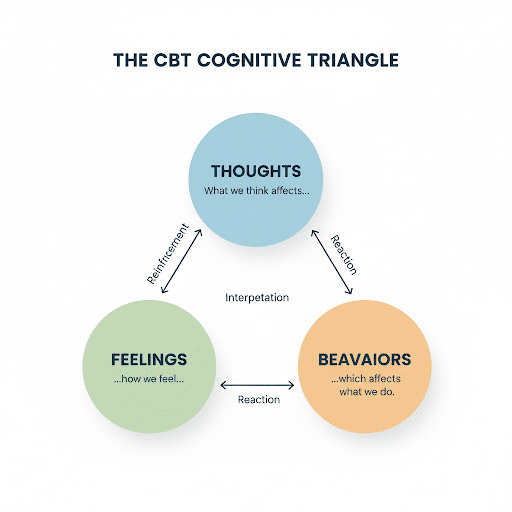
To change how you feel, you must understand the interplay between three specific pillars: Thoughts, Emotions, and Behaviors. This interconnected relationship is known as the Cognitive Triangle.
In CBT, we don’t simply “talk about the past” for the sake of history; we look at how these three points of the triangle are currently influencing one another to keep you stuck in a cycle of distress. By understanding this ecosystem, as outlined in our comprehensive guide to therapy methods, we can identify the specific “entry points” where we can intervene to break the cycle and reclaim emotional sovereignty.
The Philosophy of the Triangle: Everything is Connected
Before diving into the individual pillars, it is essential to understand the “wiring” of the triangle. The Cognitive Triangle is bidirectional and reciprocal. This means thoughts affect emotions, emotions affect behaviors, behaviors affect thoughts, and so on. It is a closed-loop system where no single element exists in a vacuum.
According to the CDC, mental health includes our emotional, psychological, and social well-being. It affects how we think, feel, and act. CBT is the practical, clinical application of this definition. It assumes that if you are struggling in one area—say, you are feeling a deep sense of loneliness—it is inevitably being fueled by what you are thinking and what you are doing (or not doing).
This framework is a core component of CBT mindset and personal transformation. It suggests that we are not victims of our moods, but rather active participants in a system that we have the power to influence. When you change one corner of the triangle, the other two must, by the laws of psychological physics, shift in response.
1. Thoughts: The Narrative Engine of the Mind
The first pillar of CBT is the Cognitive Stream. Every second of the day, your brain is performing a monumental task: it is interpreting an endless stream of data from the world around you. These interpretations are what we call “Thoughts.”
The Power of Automatic Thoughts (ANTs)
Most of our thoughts aren’t conscious, deliberate decisions. Instead, they are “Automatic Thoughts”—split-second judgments that flash through the mind like lightning. If a friend walks past you without waving, your brain instantly produces a narrative: “They’re ignoring me” or “I must have offended them.” CBT focuses on thoughts because they are the “lens” through which you view reality. If you believe your lens is perfectly clear, you accept every thought as an absolute, objective truth. However, our lenses are often distorted. When we operate on CBT single mother support or high-stress management, we see how these distortions can amplify daily pressures into insurmountable obstacles.
Common Cognitive Distortions
- All-or-Nothing Thinking: Seeing things in black-and-white. If a task isn’t perfect, it’s a total failure.
- Catastrophizing: Blowing things out of proportion. A small mistake at work becomes a “sign” that you will be homeless by next month.
- Mind Reading: Assuming you know what others are thinking without evidence. Usually, we assume they are judging us.
- Overgeneralization: Taking one negative event and seeing it as a never-ending pattern of defeat.
When we focus on the “Thought” corner of the triangle, we aim for Accurate Thinking. By identifying and challenging these distortions, we change the data the rest of our system has to work with. This process is essential for managing emotional triggers and building long-term resilience.
2. Emotions: The Body’s Signal System
The second pillar is Emotions. This is usually the corner of the triangle that brings people to therapy. We feel “bad,” “heavy,” “jittery,” or “numb.”
Emotions as Signals, Not Threats
In the CBT model, we view emotions as signals. An emotion is your body’s way of providing feedback about your environment and your internal state. However, as the NIH Emotional Wellness Toolkit points out, while emotions are vital, they can become overwhelming when we feel we have no control over them.
One of the most liberating realizations in CBT is that emotions are the part of the triangle we have the least direct control over. You cannot simply “will” yourself to stop feeling sad or anxious. If you try to suppress an emotion, it often rebounds with greater intensity. This is why CBT focuses on thoughts and behaviors as “entry points” to influence emotion, especially during emotional overload.
The Neurobiology of Emotion
Research from the NIMH shows that CBT actually alters brain activity in the areas responsible for emotional regulation, such as the prefrontal cortex and the amygdala. By changing the input (thoughts) and the output (behaviors), we effectively rewire the middle-man (emotions). When you realize, “That’s actually just a large stump” instead of a bear, your terror subsides because the “threat” has been cognitively dismantled.
3. Behaviors: The Reinforcement Loop
The third pillar is Behavior. This includes your actions, your speech, and—critically—your “avoidance behaviors.” Actions provide the “proof” for our thoughts, creating a reinforcement loop.
How Action Reinforces Belief
If you believe you are socially awkward (Thought), you will likely feel anxious (Emotion). To cope, you might stay in the corner at a party and check your phone (Behavior). Because you didn’t interact, your brain says, “See? Nobody talked to us,” proving the negative thought true. This cycle is frequently seen in CBT for relationships, where fear of vulnerability leads to distancing behaviors that eventually kill the connection.
Safety Behaviors and Avoidance
Many behaviors CBT addresses are “Safety Behaviors”—things we do to prevent a feared outcome. While these reduce anxiety in the short term, they keep the triangle locked:
- Avoidance: Not taking the job interview because you fear rejection.
- Checking: Constantly asking a partner “Are we okay?” to quell a fear of abandonment.
- Procrastination: Delaying a project because you fear you won’t do it perfectly.
By changing the behavior—Behavioral Activation—you provide your brain with new evidence. When you do the thing you fear and the catastrophe doesn’t happen, the “Thought” corner is forced to update. This is the foundation of emotional intelligence and EQ CBT training.
The Power of the Interconnection: Deep-Dive Examples
To truly understand how to use the Cognitive Triangle, let’s look at several real-world scenarios. Each example shows the “Stuck Cycle” (how the triangle traps us) followed by the CBT Reframe (how we break free).
Scenario 1: The Late Reply (Social Anxiety & Mind Reading)
- The Trigger: You text a friend to hang out, and they don’t reply for six hours.
- The Stuck Cycle: * Thought:“They are annoyed with me. I’m too needy and people eventually get tired of me.”
- Emotion: Rejection, shame, and a “sinking” feeling in the stomach.
- Behavior: Deleting the message thread, “pre-emptively” ghosting the friend, or obsessively checking your phone.
- The CBT Reframe: * New Thought:“I don’t actually have evidence that they are mad. They are likely busy at work or haven’t seen the phone. Their silence is about their schedule, not my worth.”
- New Emotion: Mild curiosity or patience instead of crushing shame.
- New Behavior: Put the phone in another room. Focus on a productive task. Wait for a response before making any further judgments.
Scenario 2: The Critical Performance Review (Career & Catastrophizing)
- The Trigger: Your boss gives you “constructive feedback” on one part of a project.
- The Stuck Cycle:
- Thought: “I’m going to get fired. I can’t do anything right. My career is over.”
- Emotion: Panic, dread, and a racing heart.
- Behavior: Over-working until 2 AM to “fix” it, or shutting down and not doing any work out of fear.
- The CBT Reframe:
- New Thought: “Feedback is a tool for growth, not a notice of termination. I did 90% of the project well; this 10% is just an adjustment. I am still a capable employee.”
- New Emotion: Determination and moderate concern (which is healthy) instead of paralyzing panic.
- New Behavior: Ask for a follow-up meeting to clarify the steps. Work standard hours to prevent burnout and maintain long-term quality.
Scenario 3: The Missed Workout (Health & All-or-Nothing Thinking)
- The Trigger: You planned to go to the gym but had to stay late at work.
- The Stuck Cycle:
- Thought: “I’ve already ruined my health goals for the week. I might as well just eat junk food tonight since I’ve failed anyway.”
- Emotion: Guilt, defeat, and self-loathing.
- Behavior: Ordering a large pizza and skipping the rest of the week’s workouts because “what’s the point?”
- The CBT Reframe:
- New Thought: “A missed workout is a single data point, not a failure of the whole system. Doing 10 minutes of stretching at home is better than doing nothing. I haven’t ‘failed’ unless I stop trying.”
- New Emotion: Compassion and balanced perspective.
- New Behavior: Do a short home workout. Eat a balanced meal as originally planned. Resume the gym schedule tomorrow.
Scenario 4: The Parenting “Meltdown” (Stress & Personalization)
- The Trigger: Your toddler has a tantrum in the grocery store.
- The Stuck Cycle:
- Thought: “Everyone is looking at me. They think I’m a terrible parent who can’t control their child. I am failing at this.”
- Emotion: Shame, anger, and heat in the face.
- Behavior: Yelling at the child to stop, or leaving the groceries and fleeing the store in tears.
- The CBT Reframe:
- New Thought: “Toddlers have tantrums; it’s a biological developmental stage, not a referendum on my parenting. Most people here have been in my shoes or don’t care at all.”
- New Emotion: Calmness and focus.
- New Behavior: Take a deep breath. Kneel down to the child’s level. Use a calm voice. Finish the shopping at a steady pace.
The Strategic Advantage of Targeting the Triangle
Why do we spend so much time mapping these three points? Because it prevents us from playing “Whack-A-Mole” with our problems. If you only try to change your behavior (e.g., “I will just stop procrastinating”), but you don’t address the underlying thought (e.g., “If this isn’t perfect, it’s garbage”), the behavior change won’t stick. The thought will eventually pull the behavior back into the old pattern.
By addressing all three corners, you create a pincer movement on your distress:
- Cognitive Work: You drain the power from the negative narrative.
- Behavioral Work: You stop providing the “proof” that keeps the narrative alive.
- Emotional Result: The intensity of the pain decreases, giving you the clarity to keep going.
Practical Tools: How to Balance Your Triangle Today
To begin applying this to your own life, you need a set of daily “checks” to ensure you are operating from the Observer Mindset rather than the Auto-Pilot.
1. The ABC Model (Targeting Thoughts)
The ABC model is the gold standard of CBT tools. Use it whenever you feel a sudden drop in mood:
- A (Activating Event): The objective, camera-lens fact. (e.g., “The car wouldn’t start.”)
- B (Beliefs): The thought your brain produced. (e.g., “I’m always unlucky. This day is going to be a disaster.”)
- C (Consequences): The resulting emotion and action. (e.g., Feeling hopeless; slamming the car door.)
- D (Dispute): The challenge. (e.g., “Is it true I’m always unlucky? No, I’ve had plenty of good luck. A car not starting is a mechanical issue, not a cosmic sign. I can call a tow.”)
2. Affect Labeling (Targeting Emotions)
As research from the CDC suggests, measuring and naming emotional states is a key part of well-being. Simply naming an emotion changes brain chemistry. Instead of “I’m overwhelmed,” identify if it’s “frustration” or “shame.” This moves processing to the logical prefrontal cortex, which acts as a natural brake on the emotional centers of the brain.
3. Behavioral Activation (Targeting Behaviors)
When your triangle wants you to isolate or give up, perform a “Technical Success.” This is a small action that is 100% within your control. It could be washing three dishes, making your bed, or sending one email. This sends a signal back to the thought corner: “We are not helpless. We are capable of impacting our environment.”
Overcoming the “Automatic” Nature of the Triangle
One of the biggest hurdles in CBT is that the triangle moves fast. By the time you realize you are in a “Stuck Cycle,” you might already be halfway through the behavior. This is why Awareness is so critical. You have to learn to catch the thought while it’s still in the air.
Think of your mind as a high-speed train. The thoughts are the tracks. If you don’t like where the train is going, you have to switch the tracks before the train reaches the cliff. This takes practice. In the beginning, you might only realize what happened after the “crash.” That’s okay. Reviewing the “crash” through a Thought Record is how you learn to spot the signals earlier next time.
Conclusion: Reclaiming Your Sovereignty
CBT focuses on thoughts, emotions, and behaviors because they are the three primary levers of the human experience. They are the only things we can truly work with to change our internal world. When you understand the Cognitive Triangle, you no longer feel like your moods are random storms that you must simply endure. You realize you are an ecosystem.
By shifting from a passive character in your life to an active “Scientist of the Self,” you reclaim your sovereignty. You learn that while you may not be able to control every drop of rain (your emotions), you can certainly manage the soil (your thoughts) and choose where to plant your seeds (your behaviors).
You are the sky—vast, stable, and capable of containing any weather that passes through. The Cognitive Triangle is simply the map that helps you navigate the storm until the sun comes out again.
Frequently Asked Questions
Which part of the triangle is the most important? There is no “most important” part, but Behavior is often the easiest “entry point” because you can physically move your body even when your thoughts are negative and your emotions are heavy. However, Thoughts are where the long-lasting structural change happens.
How long does it take to change a cycle? Neuroplasticity takes time. Most people start to see significant shifts in their “Automatic Thoughts” after 8 to 12 weeks of consistent practice. It’s like training a muscle; consistency is more important than intensity.
Can I use the Cognitive Triangle for positive emotions too? Absolutely! Thinking “I am grateful for this moment” (Thought) leads to “Contentment” (Emotion), which leads you to “Slowing down and enjoying the view” (Behavior). The triangle is a tool for life, not just for crisis.
Take Your Next Step Toward Balance
- Audit Your Triangle: For the next 24 hours, try to catch one “Thought,” one “Emotion,” and one “Behavior” and see how they are linked. Write them down.
- Deepen Your Knowledge: Read our guide on Why Awareness is the Essential First Step.
- Get Personalized Help: Contact me if you’re ready to map your cycles and break free from the auto-pilot for good.
👉 BetterMindClub.com – Empowering Your Journey to Authentic Living
