You’re Not Broken—You’re Patterned: How Women Can Break the Loop with CBT
By BetterMindClub.com
For many women, the internal monologue follows a punishing script: “Why am I like this?” “I should be further along by now,” or the most damaging of all—“I’m just broken.” Whether it’s a cycle of people-pleasing, chronic self-doubt, or the paralyzing fear of failure, we often mistake our patterns for our personality. We believe these struggles are fundamental flaws in our character, leading to a state of permanent “unfixability.”
At Better Mind Club, we want to shift that narrative entirely. You are not broken. You are simply patterned. These patterns are often survival mechanisms—highly efficient shortcuts your brain created to keep you safe, accepted, or useful in the past. By adopting a CBT mindset for healing and personal transformation, you can identify these blueprints and begin the work of conscious redesign.
The “Broken” Myth vs. The “Patterned” Reality
The feeling of being “broken” is a heavy, static state. It implies something is missing or irreparable. When we label ourselves as “broken,” we stop looking for solutions and start looking for excuses to hide. However, neuroscience and Cognitive Behavioral Therapy (CBT) tell a different story: your brain is incredibly plastic and constantly reorganizing itself.
Understanding Neuroplasticity
The human brain is not a static machine; it is more like a dynamic ecosystem. Official NIH overviews of CBT confirm that focusing on the connection between thoughts and behaviors is the key to restructuring negative pathways. Through a process called neuroplasticity, your brain can literally grow new connections and weaken old ones. When you understand that a “glitch” in your emotional life is a learned neural loop rather than a character flaw, the path to recovery opens.
The Hiking Trail Analogy
Your current behaviors are Neural Pathways—metaphorical “hiking trails” in your brain. If you have walked the trail of “Self-Criticism” every day for twenty years, that path is wide, paved, and easy to follow. Your brain takes that path automatically because it requires the least amount of energy. The path of “Self-Compassion,” on the other hand, might be overgrown with weeds and thorns. It’s hard to find and even harder to walk.
CBT is the process of “trail maintenance”—clearing the brush of the new path while letting the old, toxic path grow over through lack of use. This is not a matter of “willpower” or “thinking positive”; it is a matter of consistent, biological re-routing.
Why Women Are Particularly Patterned
Societal conditioning plays a massive role in how women’s patterns are formed. From a young age, many women are rewarded for traits that, in adulthood, become the very patterns that keep them stuck. We must look at these through the lens of CBT for relationships and secure connection:
- Hyper-Vigilance: This is the constant scanning of the room to ensure everyone else is happy. This was often a survival tactic to avoid conflict or ensure safety in high-stress childhood environments.
- Perfectionism: The belief that “good enough” is a failure. For many women, being “perfect” was the only way to receive validation or avoid criticism from authority figures.
- Minimization: Taking up less space, physically and emotionally. We are taught to be “polite,” which often translates to making our own needs invisible.
- Over-Responsibility: Carrying the emotional labor for partners, children, and colleagues. Women are often patterned to believe that if someone else is unhappy, it is their personal job to fix it.
According to the NIH Emotional Wellness Toolkit, resilience is built by recognizing these internal dialogues and realizing they are changeable. These are not “traits”—they are high-efficiency survival codes.
Phase 1: Mapping Your Blueprints (Identify the ANTs)
In CBT, the first step toward freedom is awareness. We start by identifying Automatic Negative Thoughts (ANTs). For women, these often manifest as “Shoulds”—the internal voice telling you how you should feel, look, or act.
The Pattern Audit
To move from “broken” to “patterned,” you must become a detached observer of your own mind. This requires a high level of Emotional Intelligence (EQ) Training to interpret internal signals correctly.
Ask yourself these three questions when you feel a dip in mood:
- The Trigger: What happened right before the feeling? (e.g., An email from my boss, my partner looking frustrated).
- The Script: What is the specific sentence my brain is saying? (e.g., “I’m going to get fired,” “I’m a burden”).
- The History: When is the first time I remember feeling this way? Often, these scripts are decades old.
Identifying these thoughts is not about self-blame; it is about data collection. Mapping the blueprint allows you to see the “architecture” of your stress. Once the thought is externalized on paper, you can treat it as a hypothesis to be tested rather than an absolute truth to be obeyed.
Phase 2: Decoupling Worth from Behavior
A core pillar of growth is the realization that your worth is a constant, not a variable. Achieving CBT emotional regulation and stability starts with the understanding that your value does not fluctuate based on your productivity, your weight, or your ability to keep everyone around you happy.
Scientific research highlighted by the NIH supports that cognitive restructuring is a primary biological mechanism for improving emotion regulation.
The Trap of Global Labeling
When we feel “broken,” we are practicing Global Labeling—a cognitive distortion where we take one mistake and apply it to our entire identity.
- Broken Thinking: “I snapped at my kids; I am a failure as a mother.”
- Patterned Thinking: “I snapped at my kids because I am patterned to over-function until I burn out. My behavior was poor, but my worth remains intact.”
Decoupling your worth requires a radical shift. In the CBT framework, a mistake is simply a data point indicating that a current strategy isn’t working. If a “failure” means you are a “bad person,” your brain will hide from the truth to protect your ego.
Phase 3: Interrupting the Loop with “Behavioral Activation”
Patterns thrive on repetition. They are like a record player with a deep scratch—the needle will always fall back into the same groove unless you physically nudge it. In CBT, we call this “nudge” Behavioral Activation. This is especially important for women reclaiming healthy emotional boundaries who were never allowed to have them.
The CDC explains that CBT helps individuals understand and change the link between thoughts, feelings, and behaviors. This process is strengthened by mindfulness-based CBT for emotional triggers, which teaches you to “sit in the gap” between the trigger and your response.
The “Micro-Dose” of Discomfort
Breaking a pattern isn’t about massive, life-altering changes; it’s about small, deliberate “glitches” in your usual programming.
- Identify the Pattern: For example, saying “yes” to an extra task because you fear being seen as “unhelpful.”
- The Intervention: Use a “Time-Buffer” script: “I need to check my calendar and get back to you.” This gives your logical brain time to catch up with your reactive heart.
- The Goal: You aren’t trying to feel “good” about saying no yet; you are just proving to your nervous system that you can survive the discomfort of the “No.”
Phase 4: Navigating the “Internal Pushback”
When you begin to break a pattern, your brain may trigger a “Safety Alarm.” Old patterns, like people-pleasing, were once survival tactics used to avoid conflict or abandonment.
Understanding the Extinction Burst
As you change, you may experience an “extinction burst”—a temporary increase in the frequency or intensity of an unwanted behavior just before it starts to disappear. When you stop feeding an old pattern (like the pattern of over-explaining), it will “starve” and get louder, trying to trick you back into the old comfort zone. Knowing this is a normal part of the process is vital to maintaining authenticity and bridging your public and private selves.
Phase 5: Building the New Trail (Neural Re-Patterning)
You cannot simply “delete” an old pattern; you must build a new one that is more attractive to your brain. To do this effectively, utilize free CBT tools and thought record worksheets to track your progress and provide tangible proof of your evolution. The APA guidelines emphasize that modifying these thoughts is the gold standard for treating various conditions.
Affirmation vs. Accurate Statement
If you feel like a failure and say “I am a success,” your brain knows you’re lying. Instead, use Accurate Statements:
- Old Pattern: “I am broken and unlovable.”
- New Accurate Statement: “I am a person with some deeply ingrained habits from my past, and I am currently learning how to respond to my life with more clarity.”
Phase 6: Recognizing the Somatic Connection
Patterns aren’t just in your head; they are in your body. For women, patterns of suppression or over-functioning often manifest as physical tension—tightness in the chest, a clenched jaw, or digestive issues.
The Body as a Compass
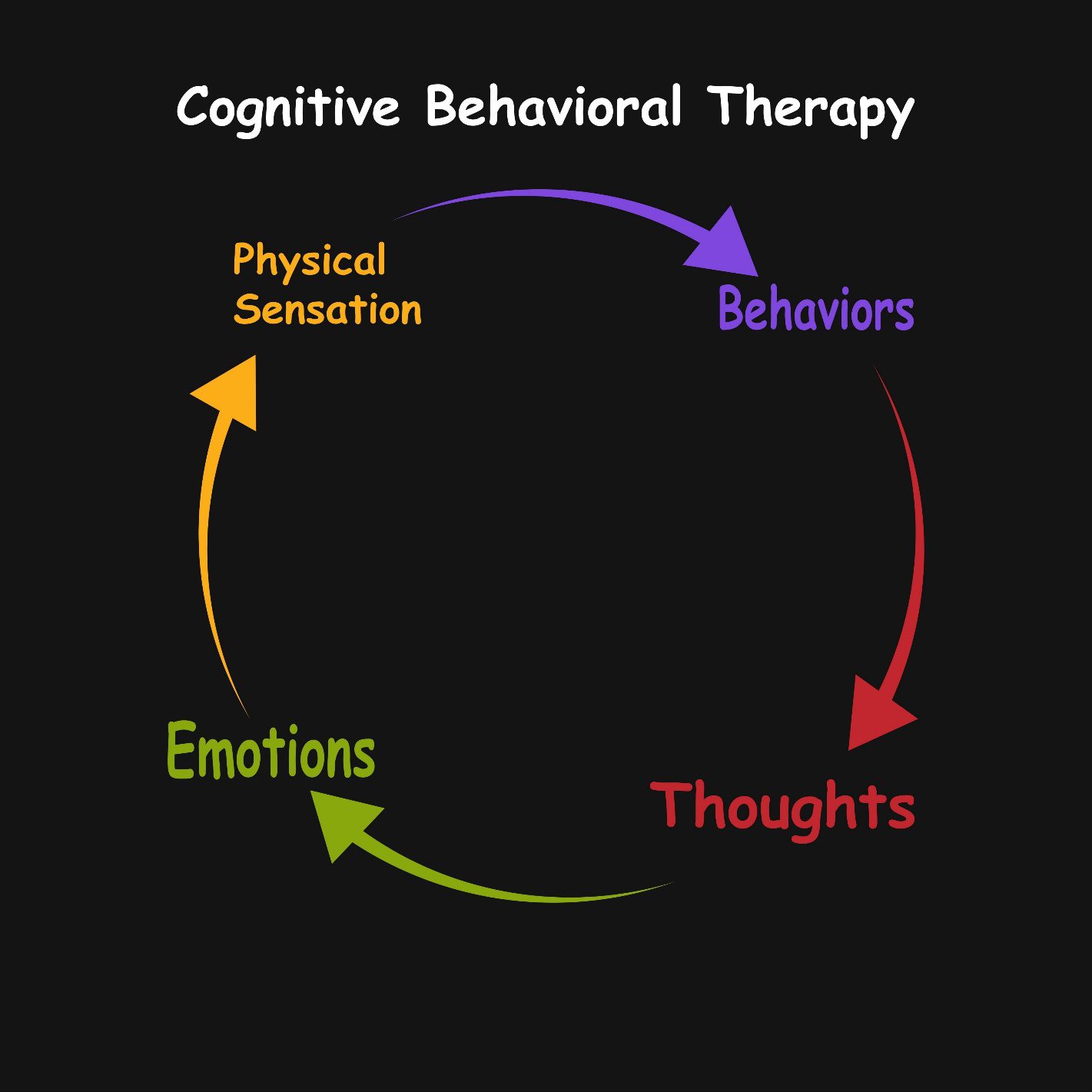
To break the loop, you must learn to listen to the “body’s blueprint.” CBT teaches us that thoughts, feelings, and sensations are a feedback loop.
- Physical Cue: You feel your throat tighten when you’re about to ask for what you need.
- Identify the Pattern: “Ah, this is my ‘Minimization Pattern.’ My body is trying to keep me quiet to avoid conflict.”
- Intervention: Take a deep breath to relax the throat and speak anyway.
Phase 7: The Role of Community and Social Reframing
We do not form patterns in a vacuum, and we rarely break them in one. Women are often patterned to be “islands”—to handle everything themselves without asking for help. Breaking this loop requires a shift toward interdependence.
Structured environments, like the Better Mind Club Academy, provide the social support and evidence-based trainingneeded to prove that change is possible.
Real-World CBT Reframes for Women
| The Pattern | The Cognitive Distortion | The CBT Reframe |
| The Imposter | Discounting the Positive | “My brain is ignoring my wins. I will list 3 facts that prove I am qualified.” |
| The Martyr | Emotional Reasoning | “Guilt isn’t proof of selfishness. It’s proof that I’m breaking a habit.” |
| The Perfectionist | All-or-Nothing Thinking | “If this isn’t perfect, it’s still useful. I am aiming for ‘effective.'” |
| The People-Pleaser | Fear of Rejection | “I can handle someone being disappointed. Their reaction is about their patterns.” |
| The Over-Explainer | Personalization | “I have already stated my boundary. I don’t need to provide a list of excuses.” |
Frequently Asked Questions
Is it really possible to change after decades of the same behavior?
Absolutely. Neuroplasticity does not have an expiration date. While it may take more effort to “re-pave” a forty-year-old trail than a five-year-old one, the biological mechanism is exactly the same. The key is consistency over intensity.
What if my patterns are protecting me from real danger?
If your patterns are rooted in trauma or current unsafe environments, CBT is often paired with Trauma-Informed care. Safety always comes before behavioral change.
How do I know if I’m making progress?
Progress in CBT often looks like a “longer pause.” You might still have the old thought, but instead of acting on it immediately, you notice it and wait. That pause is the space where your new life is built.
Conclusion: You Are the Architect
The shift from “I am broken” to “I am patterned” is the ultimate act of self-reclamation. It moves you from the role of a faulty product to the role of an architect. You are simply living in a house you didn’t design—built with bricks of societal pressure, childhood survival, and outdated neural loops.
But today, you have the tools. By using CBT to question the old scripts and behavioral activation to build new ones, you prove to yourself that you were never broken to begin with. You were just waiting for the right set of instructions to begin the renovation.
