
CBT for Women: How to Use Cognitive Behavioral Therapy to Think Better and Feel Better
By: Mary Walden for BetterMindClub.com
Introduction: The Invisible Link Between Thoughts and Feelings
Have you ever found yourself spiraling into anxiety or dwelling on feelings of inadequacy after a minor setback?
Women often internalize stress and criticism, leading to cycles of self-doubt and emotional exhaustion. For example, interpreting a request for revision on a project as evidence that you are fundamentally unskilled is a common self-doubt cycle. The key to breaking these cycles isn’t about ignoring your feelings; it’s about changing the way you think about them.
The most powerful tool for this transformation is Cognitive Behavioral Therapy (CBT). At its core, CBT is a psychological approach that reveals a simple truth: our thoughts create our feelings, not the event itself. By learning to identify and restructure unhelpful thought patterns, you gain control over your emotional life. To learn more about the effectiveness of CBT, you can read this overview from the American Psychological Association (APA).
This guide will break down the fundamental principles of CBT, focusing specifically on how women can apply these techniques to common mental traps like perfectionism,people-pleasing, and imposter syndrome. If you are looking to build a stronger foundation against these types of self-doubt, explore our detailed guide on building Emotional Resilience through CBT principles.
The Core Mechanism: The CBT Triangle
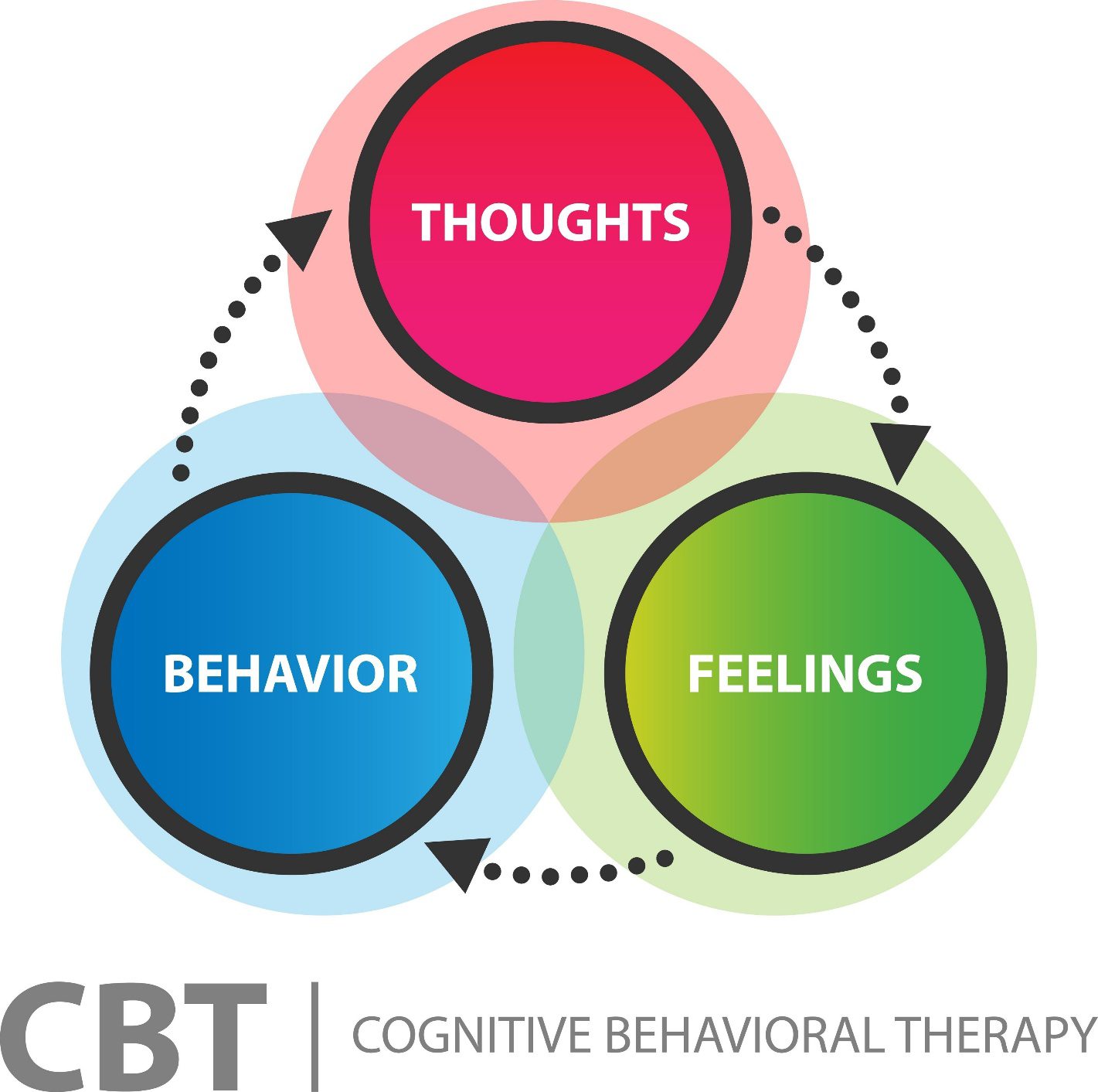
The central concept in CBT is the interconnectedness of your inner life. Think of your mind as running on three linked systems—thoughts, feelings, and behaviors—that constantly feed into each other. If you change one, the other two must change as well.
The Interconnected Triangle
The CBT model is often visualized as a triangle. When an external situation occurs (e.g., your boss cancels a meeting), the three points of the triangle activate simultaneously:
| Component | Example (Negative Script) | Example (Positive Script) |
| 1. THOUGHTS (Cognitions) | “I must have done something wrong. I’m going to get fired.” | “The boss is busy; I’ll reschedule. My work is still valuable.” |
| 2. FEELINGS (Emotions) | Anxiety, Fear, Shame. | Calmness, Focus, Mild Annoyance. |
| 3. BEHAVIOR (Actions) | Avoid eye contact, apologize excessively, overwork all weekend. | Send a quick, professional rescheduling email and continue working. |
This visualization highlights why simply trying to force yourself to feel calm (changing only the feeling) rarely works. The fastest path to better feelings is through challenging the thought.
Identifying Unhelpful Thought Patterns (Cognitive Distortions)
Before you can think better, you must identify the ways you are currently thinking wrong. CBT identifies specific patterns, called cognitive distortions, that women often fall into.
1. Mind Reading and Fortune-Telling
This distortion involves assuming you know what others are thinking or predicting a negative future outcome without concrete evidence.
- Example: Assuming a friend’s delayed text means she is angry at you (Mind Reading), or deciding in advance that your project presentation will be a disaster (Fortune-Telling).
2. Should Statements and Perfectionism
“Shoulds” are rigid rules you impose on yourself. For women, these often revolve around being a perfect partner, mother, or employee. These thoughts create intense guilt and pressure.
- Example: “I should be able to handle this entire workload without asking for help.” or “My house should always be immaculate.”
3. All-or-Nothing Thinking (Black and White)
This binary style of thinking leaves no room for gray areas. If a situation or performance isn’t perfect, it’s a total failure.
- Example: You eat one cookie while dieting and think, “Well, the whole day is ruined. I might as well eat the whole box.”
4. Emotional Reasoning
Believing that what you feel must be true, even when logic suggests otherwise.
- Example: “I feel utterly incompetent, therefore I am incompetent.” This overrides any objective proof of competence. For instance, feeling anxious before a speech does not mean you will fail; it means your body is preparing for a challenge.
Recognizing the Worst-Case Scenario: Catastrophizing
Catastrophizing is a common and powerful distortion where you inflate the potential negative outcome of a situation far beyond what is realistic. This is a primary driver of chronic anxiety.
The Catastrophic Script
- Definition: Seeing only the absolute worst, most terrifying possible result of an event, even if the probability is minuscule.
- Example 1: Your child gets a bad grade on one test $\rightarrow$ Catastrophizing:“They will fail the class, drop out of college, and end up jobless.”
- Example 2: You make one error in a meeting $\rightarrow$ Catastrophizing:“Everyone thinks I’m an idiot. I’m going to be demoted and never get another job in this industry.”
The “What Is The Likelihood?” Technique
The CBT solution is to force yourself to assign a percentage to the likelihood of the catastrophe actually occurring (usually $\le$ 5%) and plan for the most likely outcome (e.g., You’ll have to study more, or You’ll correct the error and move on). For more information on anxiety and worst-case thinking, the National Institute of Mental Health (NIMH) provides helpful resources.
The Four Steps to Restructure a Thought
Rewiring your brain to choose a healthier response is a skill that takes practice. Use this protocol whenever you feel an emotional reaction that seems disproportionate to the event.
Step 1: Catch the Thought (A.C.T.)
The moment you feel a strong negative emotion (anxiety, anger, sadness), pause and ask: “What was the specific thought that just triggered this feeling?”
- Trigger: A coworker gave you brief, critical feedback.
- Caught Thought: “He thinks I’m useless. I should quit before I fail.”
Step 2: Identify the Distortion
Compare your caught thought against the list in Section II and III. What cognitive distortion is running the script?
- Distortion: Mind Reading (“He thinks I’m useless”) combined with All-or-Nothing Thinking (“I should quit before I fail”).
Step 3: Challenge the Thought (The Courtroom Test)
Play the role of an objective defense attorney for yourself. Ask rigorous, evidence-based questions to dismantle the distortion.
- The Evidence Question: “What proof do I have that he thinks I’m useless? Did he say that? No. He gave me one piece of specific feedback.”
- The Alternative Question: “What is another, more reasonable explanation for his feedback? Maybe he is just trying to improve the project, or maybe he is having a bad day.”
- The Impact Question: “How does holding this negative thought help me? It makes me anxious and want to quit. It hurts me.”
Step 4: Create and Implement the Balanced Thought
Write a new, realistic, and balanced statement based on the evidence. This new thought becomes your action plan.
- The Balanced Thought: “His feedback is about one part of the project, not my entire worth. I am competent, and I can address his point. My goal is to improve the final product.”
- The New Behavior: Send an email thanking him for the specific input and outlining your plan to implement the changes.
Moving from Thought to Action: Behavioral Experiments
CBT isn’t just theory; it requires action. Behavioral experiments are planned actions used to test the validity of your distorted thoughts. You act against your fear to gather real-world evidence, which is often the most powerful way to weaken a negative belief.
Designing Your Experiment
| Distorted Thought (Hypothesis) | Behavioral Experiment (Test) | Evidence Collected (Result) | New Belief |
| “If I say ‘no’ to a request, my coworker will hate me.” (People-Pleaser) | Say “no, I can’t take that on” to a low-stakes request from a coworker. | The coworker was mildly disappointed but immediately accepted it and asked someone else. No relationship damage occurred. | It is safe to decline requests. My worth isn’t tied to my availability. |
| “If I delegate a task, it will be done incorrectly, and I’ll be responsible.” (Perfectionism) | Delegate a small, important task to a qualified team member and fully step back. | The task was completed correctly, perhaps even faster than I would have done it. | I can trust others. Delegation saves me time and energy. |
| “If I don’t respond to my partner’s text instantly, they will assume I’m mad.” (Distrust/Anxiety) | Wait 30 minutes before responding to a non-urgent text from your partner. | They responded normally and did not mention the delay. They were focused on their own activity. | My partner respects my personal time and doesn’t constantly monitor my availability. |
These experiments collect “votes” for your balanced thought, proving that your initial emotional prediction was just a thought, not a fact.
Interrupting Worry: The Worry Time Technique
Chronic worry is often fueled by the distorted belief that worrying is productive or prevents bad things from happening. The CBT technique of Worry Time teaches your brain to postpone worry, reclaiming mental space.
How to Implement Worry Time
- Schedule: Set aside one specific 15-20 minute period each day (e.g., 5:00 PM to 5:20 PM) to worry.
- Postpone & Write: When a worry enters your mind outside of this window, do not engage with it. Simply write the worry down on a note card or in a dedicated digital file.
- Refocus: Immediately shift your attention back to the present task, using a grounding technique (Section VII).
- Engage & Review: During your scheduled “Worry Time,” sit down and review the list. You will often find that 80% of the worries no longer feel urgent or have resolved themselves.
- Plan: For the remaining 20% of worries that are still valid, use the 4-Step Restructuring Protocol (Section IV) to challenge the thought and create a specific action plan, rather than just ruminating.
Sustaining the Shift: Mindfulness and Defusion
While cognitive restructuring changes the content of your thoughts, mindfulness helps change your relationship with them. This is crucial for long-term CBT success.
Cognitive Defusion: Separating Self from Thought
The goal of defusion is to observe a thought without automatically believing or reacting to it.
- Practice: When the thought “I am going to fail” arises, mentally add the phrase, “I am having the thought that…” so the full statement becomes: “I am having the thought that I am going to fail.”
- Effect: This subtle linguistic shift creates psychological space between you and the thought, stopping it from immediately triggering the anxiety and behavior loop. For example, if you see an email from your boss and the thought “I’m in trouble” appears, labeling it as “I am noticing the thought ‘I’m in trouble'” allows you to open the email calmly. You can choose to dismiss the thought instead of fighting it.
Grounding and Presence: The 5-4-3-2-1 Method
When an old script hits you with overwhelming force, ground yourself in the present moment to break the emotional reasoning cycle.
- Technique: Use the 5-4-3-2-1 Method: Name five things you can see, four things you can touch, three things you can hear, two things you can smell, and one thing you can taste.
- Effect: This intentionally shifts your focus from the abstract, negative rumination (the thought) to concrete, immediate sensory data, immediately reducing the intensity of the feeling. For instance, if you are ruminating in the kitchen, you might focus on: (5) the chrome of the faucet, (4) the cold feel of the counter, (3) the refrigerator hum, (2) the faint smell of coffee, (1) the taste of the gum you are chewing.
Applying CBT to Common Women’s Mental Traps
CBT is particularly effective for the social and psychological pressures women face. Understanding the broader context of women’s mental health can be insightful; resources like the World Health Organization (WHO) provide global perspectives on gender and mental wellness.
Overcoming Perfectionism
The perfectionism script often stems from the thought: “If I make a mistake, I am a failure.”
| Old Script | New Balanced Thought | Behavioral Change |
| Thought: “If this report isn’t perfect, I’ll be criticized.” | Balanced Thought: “The report needs to be good enough and on time. My value comes from completion and consistent effort, not flawlessness.” | Submit the report on time, even if you could have spent another hour tweaking minor details. |
Setting Boundaries (The People-Pleaser)
The people-pleaser script is powered by the thought: “If I say no, I will hurt their feelings and they will reject me.”
| Old Script | New Balanced Thought | Behavioral Change |
| Thought: “I can’t disappoint her by declining; my job is to make people happy.” | Balanced Thought: “My job is to manage my time and energy effectively. Saying ‘no’ to one thing allows me to say ‘yes’ to what truly matters.” | Practice the phrase: “That sounds interesting, but I don’t have the capacity for it right now.” |
Conclusion: You Are Your Own Best Therapist
CBT is not a one-time fix; it is a mental discipline. Every time you consciously catch an unhelpful thought and replace it with a balanced, evidence-based one, you are building new neural pathways. You are literally teaching your brain to prioritize rational thought over automatic emotional reactions.
By mastering the CBT Triangle, practicing cognitive restructuring, running behavioral experiments, and using defusion, you gain the power to rewrite the script of your life, reducing stress, improving relationships, and achieving sustainable well-being. Thinking better is the ultimate form of self-care.
👉 Ready to dive deeper into practical cognitive tools? Explore Our Guide on Managing Social Anxiety with CBT Techniques.
