💖 Love Languages, Needs, and Emotional Intelligence: A CBT Guide
By: Mary Walden for BetterMindClub.com
Introduction: Connecting Needs, Actions, and Feelings
Emotional Intelligence (EQ) is our ability to perceive, evaluate, and control our own emotions and the emotions of others. While EQ gives us the insight, the Five Love Languages—a concept popularized by Gary Chapman—provide the practical frameworkfor acting on that insight. The Love Languages describe the primary ways people feel and express love: Words of Affirmation, Acts of Service, Receiving Gifts, Quality Time, and Physical Touch.
However, understanding your partner’s love language isn’t enough for true relationship healing and inner transformation. We must connect these external expressions to the underlying emotional needs and use targeted cognitive-behavioral techniques (CBT) to ensure our communication is effective and our relationships are resilient. This article presents a structured, CBT-informed approach to mastering the Love Languages, focusing on turning emotional knowledge into lasting behavioral change.
For a deeper dive into foundational emotional regulation, explore our guide on Understanding and Managing Emotional Reactivity. To learn more about the broader scope of EQ, refer to Daniel Goleman’s seminal work on Emotional Intelligence.
💖 Love Languages as Primary Emotional Needs
In the context of emotional intelligence, a person’s primary Love Language is essentially their core emotional need. When this need is consistently met, they feel secure, valued, and loved. When it is unmet, it triggers negative automatic thoughts (ANTs) and emotional distress. Understanding this link is crucial for applying CBT effectively.
| Love Language | Core Emotional Need | Unmet Need Trigger | CBT Connection (Focus) |
| Words of Affirmation | The need for recognition and validation of self-worth. | Feeling insecure, unappreciated, or criticized (often triggers ANTs like “I’m not good enough”). | Challenging self-doubt and recognizing positive intentions. |
| Acts of Service | The need for support, relief, and feeling cared for. | Feeling overburdened, unseen, or like the partner is irresponsible(often triggers ANTs like “I have to do everything myself”). | Modifying avoidant behaviors and managing the assumption of helplessness. |
| Receiving Gifts | The need for thoughtfulnessand visible proof of being a priority. | Feeling forgotten, unimportant, or disposable (often triggers ANTs like “They don’t think about me when I’m gone”). | Reframing material value and focusing on the emotion behind the gesture. |
| Quality Time | The need for focused attention,connection, and being present. | Feeling lonely, ignored, or disengaged (often triggers ANTs like “They don’t enjoy being with me”). | Practicing mindfulness and reducing digital distractions during interactions. |
| Physical Touch | The need for safety, security, and non-verbal reassurance. | Feeling distant, unloved, or rejected (often triggers ANTs like “My partner is pulling away from me”). | Integrating body awareness and managing fears of intimacy/rejection. |
The CBT-EQ Framework for Relationship Mastery
The goal of using CBT with Love Languages is to help individuals identify and challenge the cognitive distortions that arise when their core emotional needs are threatened.
1. Identifying the Cognitive Distortion (The ANTs)
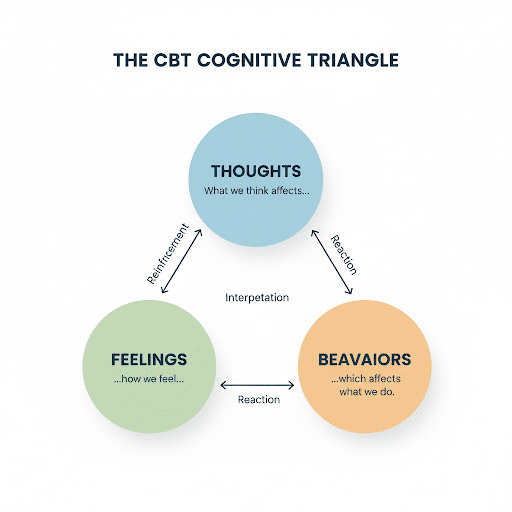
When a partner misses a cue related to your primary Love Language, it often triggers immediate, negative thoughts—the ANTs (Automatic Negative Thoughts). These thoughts are rarely accurate but drive reactive, emotional behavior.
This image illustrates the CBT Cognitive Triangle, depicting the interconnected relationship between Thoughts, Feelings, and Behaviors…
- Example (Unmet Acts of Service): Your partner consistently leaves dishes in the sink.
- ANT: “They don’t respect me or my time. They’re lazy. I’m responsible for everything.” (This is a type of “Mind Reading” or “Personalization” distortion, common in relationship distress.)
- Example (Unmet Words of Affirmation): Your partner accepts a big promotion at work but only says, “That’s good news.”
- ANT: “They don’t genuinely care about my success; they are clearly jealous. My achievements don’t matter to them.” (This is “Jumping to Conclusions” or “Emotional Reasoning” distortion.)
- Example (Unmet Quality Time): Your partner brings their phone to dinner and checks it frequently.
- ANT: “I am boring. Their phone is clearly more important than I am. Why do I even bother trying to connect?” (This is “Labeling” or “All-or-Nothing Thinking” distortion.)
- Example (Unmet Receiving Gifts): Your partner forgets your anniversary until the day of, then quickly buys a generic gift card.
- ANT: “They completely forgot about me. I am not a priority in their life. Our relationship is meaningless to them.” (This is “Filtering” or “Catastrophizing”distortion.)
- Example (Unmet Physical Touch): Your partner avoids cuddling on the couch, preferring to sit a few feet away.
- ANT: “They are physically repulsed by me. They must be angry or having an affair. I am going to be rejected.” (This is “Fortune Telling” or “Personalization” distortion.)
2. The Thought Record: Challenging the Distortion
Using a CBT Thought Record, you challenge the ANT by seeking evidence and alternative interpretations. This is the application of emotional intelligence to a specific relationship conflict. For a detailed guide on this powerful technique, see our resource on CBT Thought Records: Challenging ANTs.
- Challenge Question (Acts of Service): Is it 100% true that they leave the dishes because they don’t respect me? Could there be another explanation?
- Evidence Against the ANT: They went out of their way to fill my car with gas yesterday, which was an act of service. They are currently overwhelmed by a tight deadline at work and seem genuinely stressed.
- Balanced Reframe: “My partner is struggling with time management due to work stress right now, not intentionally disrespecting me. I can communicate my need assertively and offer to collaborate on a solution instead of suffering silently and letting resentment build.”
- Challenge Question (Words of Affirmation): What is the evidence that my partner is jealous or uncaring, vs. just bad at expressing verbal praise?
- Evidence Against the ANT: Last week, they spent two hours helping me prepare for this promotion. They shared the news immediately with their mother. They told me I deserved it months ago.
- Balanced Reframe: “My partner shows me love through Acts of Service, not Words of Affirmation. Their quiet response doesn’t mean they don’t care; it means I need to teach them how to validate me using my language. I will ask for specific verbal praise.”
- Challenge Question (Receiving Gifts): Is the generic gift card truly proof that the entire relationship is meaningless, or does it prove they tried to salvage the situation under pressure?
- Evidence Against the ANT: They still remembered the anniversary, even if late. They meticulously planned my surprise 30th birthday party last year. Their primary love language is Quality Time, which they offer daily.
- Balanced Reframe: “The late gift means their memory failed, but not their devotion. I need to appreciate the last-minute effort while using assertive communication to explain why thoughtfulness, not speed, is key to my love language.”
- Challenge Question (Physical Touch): What is the evidence that my partner is repulsed by me, vs. evidence they are preoccupied or tired?
- Evidence Against the ANT: They initiated a hug before leaving for work this morning. They often hold my hand when we walk. They mentioned earlier they were physically exhausted from a long workout.
- Balanced Reframe: “My partner is likely just physically tired and needs space right now, not rejecting me. I can respect their need for space, and initiate a non-demanding touch later to check in.”
3. Behavioral Rehearsal: Assertive Communication
The final step is to replace the emotional reaction (like passive-aggressive sighing or withdrawing) with assertive communication. This is where the integration of the Love Language becomes a skill. The goal is to communicate the need without judgment, fostering genuine understanding and problem-solving.
- Ineffective Response (Acts of Service): (Reacting from unaddressed ANTs and potential Shadow aspects) “I see you didn’t do the dishes again. You obviously don’t care about the state of our home or how much work I do.”
- Effective, Assertive Response (Acts of Service): (Using the D-E-S-C script) “I feel stressed and overwhelmed when the kitchen is messy (Describe the situation, Express your feelings). Could we agree that Acts of Service are important to me, and that the dishes need to be done before we sit down for dinner (Specify your request)? What are your thoughts on how we can make this happen (Consequences/Collaborate)?”
This image displays the D.E.S.C. Assertive Communication Script, a four-step framework for clear and effective communication…
- Effective, Assertive Response (Quality Time): (Addressing the phone distraction) “When you look at your phone during our dinner dates (Describe), I feel hurt and disconnected because I look forward to this focused time (Express). Could we agree to leave our phones in the next room for the next hour so we can really focus on each other (Specify)? This will help me feel like I am your priority tonight (Consequences/Collaborate).”
- Effective, Assertive Response (Receiving Gifts): (Addressing non-thoughtful gifts) “I appreciated you thinking of me for my birthday (Expressing appreciation for the intent). However, the reason gifts mean so much to me is the thoughtfulness behind them, not the price (Describe/Context). Could you try spending less money, but maybe writing down a specific memory we shared and giving me that next time (Specify)? That would mean the world to me (Consequences).”
- Effective, Assertive Response (Physical Touch): (Addressing the lack of non-sexual touch) “When we haven’t touched all evening (Describe), I start to feel really disconnected and insecure (Express). Could we set aside 10 minutes before bed just for a quick cuddle or foot rub to reconnect (Specify)? That little bit of reassurance helps me feel safe and loved all night (Consequences/Collaborate).”
Mastering Each Language Through Behavioral Change
Applying CBT to each Love Language requires targeted behavioral practice and cognitive reframing. This disciplined approach builds new neural pathways that support genuine inner transformation and relationship healing.
| Love Language | CBT Technique | Behavioral Goal | Self-Compassion Check |
| Words of Affirmation | Gratitude Journaling:Actively record 3 specific affirmations you gave your partner and 3 they gave you daily. | Increase frequency of specific, non-generic praise (e.g., “I appreciate how patient you were with the customer service agent today”). | If you forget to praise:“I made a mistake, not a character flaw. I will send an encouraging text now.” |
| Acts of Service | Behavioral Scheduling:Schedule one small, deliberate Act of Service for your partner daily (e.g., “Take out trash before 6 PM”). | Reduce assumptions that tasks will magically happen; focus on proactive, observable action. | If you feel resentful: “I need to assertively ask for help or delegate. My needs matter, too.” |
| Receiving Gifts | Cognitive Reframing of Value: When receiving a gift, challenge ANTs about its price or size. Focus instead: What specific thought did this require of them? | Increase emotional receipt: Practice expressing deep appreciation for the thought, not the item, reinforcing that the thoughtfulness is the need being met. | If the gift is generic:“Their intent was positive. I can gently guide them for next time; love is a learning process.” |
| Quality Time | Mindfulness Practice (Digital Detox): Schedule “sacred time” blocks (30 mins minimum) where all devices are physically out of sight. | Increase presence:Practice active listening; use open-ended questions and focus entirely on the non-verbal cues of your partner. | If your mind wanders:“It’s normal to get distracted. I’ll take a deep breath and gently return my focus to their words now.” |
| Physical Touch | Sensory Integration:Consciously initiate touch outside of sexual contexts (e.g., resting a hand on their shoulder, holding hands during a walk). | Normalize non-demanding contact:Reduce the fear that touch must lead to a larger commitment; use touch for simple reassurance and connection. | If touch is rebuffed:“Their boundary is about their current comfort or mood, not my lovability. I will respect the space and try again later.” |
Sustaining Connection and Growth
To make the progress gained through Love Language awareness and CBT last, focus on these ongoing practices:
- Regular Check-ins: Schedule weekly “relationship temperature checks” to discuss how well each other’s Love Languages are being met. Frame these discussions using “I” statements to avoid triggering defensiveness (e.g., “I feel my love tank is a little low in the Quality Time area this week”). This proactive approach prevents small issues from escalating.
- Empathy Practice (Role Reversal): Actively try to see situations from your partner’s perspective, especially when their reaction seems disproportionate to your own interpretation. A powerful EQ exercise is Role Reversal: imagine explaining your partner’s action (e.g., forgetting a gift) as if you were them, focusing on their reasons and feelings. This builds empathy, a cornerstone of EQ.
- Relapse Prevention Planning: In CBT, anticipating difficult times is key. Identify specific high-stress scenarios (e.g., busy work weeks, illness, major holidays) that typically cause you to miss your partner’s love language cues. Create “If-Then” plans for these times (e.g., “If I have a deadline that prevents Quality Time, then I will immediately pre-schedule a 30-minute, uninterrupted walk for Sunday”).
- Self-Compassion: Remember that growth is not linear. There will be setbacks. Practice self-compassion when you or your partner fall short, and recommit to the process of learning and adapting. Learn more about cultivating self-kindness in our article on The Power of Self-Compassion in Healing.
- Validation Techniques: Actively practice emotional validation. This means acknowledging and respecting your partner’s feelings, even if you don’t agree with the reason. A simple validation technique is: “I can see you feel upset because the house is messy (Acts of Service). Your feelings make sense, and I hear that this is important to you.” This diffuses conflict and meets the underlying need for recognition.
- Professional Guidance: For persistent relationship challenges, consider seeking guidance from a therapist or relationship counselor who can provide tailored CBT strategies. To explore personalized support and connection with experts, visit the Better Mind Club Contact Page.
Conclusion: Transforming Relationships Through Awareness
Mastering the Love Languages with Emotional Intelligence and CBT is an essential path to inner transformation within a relationship context. By treating your partner’s Love Language as their most vulnerable emotional need, and using CBT to challenge the internal noise (ANTs) that arises during conflict, you replace destructive reactivity with productive, assertive communication.
This journey shifts the focus from passively feeling loved to actively creating love through informed behavior, leading to greater intimacy and lasting emotional healing.
Ready to apply these techniques to your relationship? 👉 Explore our CBT resources and download your. Find more tools and support at https://bettermindclub.com/.
