
🧘 Healing, Shadow Work & Inner Transformation: A CBT-Informed Guide
By: Mary Walden for BetterMindClub.com
Introduction: The Journey to Wholeness
Inner transformation is the profound process of consciously shifting your limiting beliefs, behaviors, and emotional patterns. This creates a more authentic, fulfilling life. This journey requires deep self-awareness, courage, and commitment. Central to this process is Shadow Work. This is the psychological practice of integrating the repressed, ignored, or disowned parts of your personality, often referred to as the Shadow self. When these hidden aspects remain unaddressed, they fuel anxiety, self-sabotage, and relational conflicts.
This article, presented by BetterMindClub.com, provides a structured approach. This approach is rooted in Cognitive Behavioral Therapy (CBT) principles. It is designed for engaging in effective Shadow Work and achieving lasting emotional healing. We will guide you through recognizing the Shadow, engaging with your inner critic, and integrating these elements for true self-mastery.
Ultimately, the aim of this therapeutic work isn’t perfection; it’s wholeness. By addressing the fractured parts of the self, you cease fighting internal conflicts. This, in turn, frees up immense psychological energy. This renewed energy can then be intentionally directed toward building the life you genuinely desire. Consequently, this makes the work of inner transformation deeply practical and rewarding.
Understanding the Shadow Self: The Hidden Key to Growth
The concept of the Shadow was popularized by Swiss psychiatrist Carl Jung’s Work on the Shadow Self. It represents the parts of your ego that you deem unacceptable. As a consequence, you hide these parts from both yourself and the world. These parts aren’t inherently “bad”; they are simply unacknowledged.
The Shadow typically contains:
- Repressed Emotions: Deeply buried feelings like grief, anger, or shame.
- Disowned Traits: Qualities you judge harshly, such as aggression, laziness, or selfishness.
- Unrealized Potential: Talents, gifts, or desires you were conditioned to suppress.
When you fail to engage with the Shadow, it doesn’t disappear; it projects. This projection manifests as intense, often irrational, dislike or judgment of specific traits in other people. For instance, if you find yourself consistently triggered by another’s arrogance, your own suppressed desire for power may reside in your Shadow. Recognizing these triggers is the first step toward inner transformation.
Therefore, the Shadow can be understood as an unconscious reservoir of vitality and potential. However, this potential has been emotionally walled off. The initial goal of Shadow Work is to build a bridge to this reservoir. This allows you to access the creativity, assertiveness, and power that were inadvertently suppressed alongside the undesirable traits. By consciously retrieving these assets, the process drives comprehensive healing.
Furthermore, the Shadow often appears in our dreams, myths, and stories as dark figures, villains, or antagonists, symbolizing the aspects we fear or resist within ourselves. Paying attention to these symbolic representations can provide clues to the specific contents of your personal Shadow. The deliberate act of confronting these interior “enemies” is what leads to genuine psychological integration and personal maturity.
The Integration Imperative: Why We Must Embrace the Dark
The process of acknowledging the Shadow is crucial because suppressed traits require immense emotional energy to keep hidden. This constant, internal policing leads to chronic fatigue, anxiety, and emotional reactivity. When we integrate a Shadow element, we effectively reclaim that spent energy. For example, integrating the “selfish” part allows us to set healthy boundaries without guilt. This ultimately frees us to become more authentic and less reactive in our day-to-day lives, demonstrating the practical necessity of Shadow Work for deep-seated inner transformation.
The Cognitive Barrier: The Inner Critic and ANTs
The largest obstacle to beginning Shadow Work is the Inner Critic. This critic operates using Automatic Negative Thoughts (ANTs). It interprets any attempt at introspection or vulnerability as weakness. This ensures the Shadow remains hidden behind layers of defense.
| Inner Critic ANT | Shadow Work Reality |
| “If I look at my anger, I’ll become a monster.” | Acknowledging anger allows you to manage it; suppression lets it control you. |
| “Shame means I am fundamentally broken.” | Shame is an emotion, not an identity; it is a signal that requires compassion, not condemnation. |
| “This is too painful to deal with.” | The pain of avoidance is greater than the pain of conscious healing. |
CBT provides tools to challenge these cognitive distortions. By identifying the ANTs and replacing them with balanced, compassionate reframes, you create a safe mental space. This space is necessary to approach the dark material of the Shadow without self-destruction. This is the bedrock of lasting inner transformation.
Moreover, learning to distinguish the Inner Critic’s voice from your rational, authentic self is a critical CBT skill. This skill must precede deep Shadow Work. The critic often speaks in absolutes (“always,” “never”) and focuses solely on deficits. Conversely, your rational self acknowledges nuance and potential for change. Developing this awareness acts as your internal security check. This prevents the automatic absorption of damaging self-judgments that maintain the Shadow’s isolation.
The BetterMindClub.com Methodology: Three Pillars of Shadow Work
Our structured approach turns abstract Shadow Work into actionable practices for emotional healing.
1. Shadow Mapping: Identification Through Projection
Instead of forcing yourself to look directly at what you fear, you can use external triggers as a map to your Shadow.
- The Method (The Projection Reversal): When someone or something triggers a disproportionately strong negative emotional reaction (intense annoyance, judgment, or disgust), pause and ask: “What am I seeing in them that I refuse to see in myself?”
- Example: You intensely despise your colleague’s need for constant external validation. Shadow Mapping suggests your own need for validation might be buried. Your judgment is a defense mechanism against that personal vulnerability.
- Example: You are deeply annoyed by friends who leave jobs easily, viewing them as irresponsible. Shadow Mapping suggests your own suppressed desire for freedom or lack of willingness to take career risks may be residing in your Shadow.
- Example: You feel intense, moral outrage when a public figure engages in petty gossiping. Shadow Mapping suggests the part of you that enjoys—but rigorously suppresses—the urge to judge or gossip about others is seeking expression.
- The Healing Connection: By identifying the projected trait, you move it from the external world back into your internal awareness. This makes it available for conscious integration. This facilitates profound inner transformation.
Furthermore, the technique of Projection Reversal actively breaks the self-deceptive cycle of blame. By consciously shifting your focus from the external source of irritation (the other person) to the internal discomfort it highlights, you effectively regain emotional sovereignty. This vital shift transforms a draining conflict into an empowering opportunity for self-discovery and growth.
2. Compassionate Re-parenting: befriending the Disowned Self
The repressed parts of the Shadow often feel like abandoned children. Healing requires treating these parts with the nurturing attention they never received.
- The Method (The Dual Dialogue): Identify a Shadow part (e.g., the part that procrastinates out of fear of failure). Instead of criticizing it, mentally communicate with it as a compassionate adult would speak to a struggling child.
- Example: Instead of, “You’re lazy and worthless,” the dialogue becomes, “I see you are feeling a deep fear of failure right now. That feeling is overwhelming. Thank you for showing me this fear. What do you need to feel safe enough to try?”
- Example: When you experience intense sadness over a minor slight, the dialogue shifts from, “Stop being so sensitive and dramatic,” to, “I see the deeply hurt part of me is surfacing. I know you feel pain easily. I’m here now, and we can process this feeling gently.”
- Example: When the impulse to isolate and withdraw arises, the dialogue shifts from,“You are antisocial and weak,” to, “I understand you are feeling tired and vulnerable. It is okay to need rest, but let’s schedule one positive social interaction later this week so we don’t feel totally disconnected.”
- The Healing Connection: This process replaces the Inner Critic’s judgment with acceptance. This reduces internal conflict and lays the groundwork for integration. This deliberate self-kindness is essential for deep healing.
Consequently, making this mental dialogue a regular habit gradually reduces the overall intensity of your negative self-talk. Recognizing that the painful voices are symptoms of a neglected part—rather than absolute truths about your character—allows you to respond with empathy instead of defense. This consistent compassionate response fosters deep internal safety. This is crucial for moving forward with your Shadow Work.
3. Integration through Conscious Action
The final step in Shadow Work isn’t just understanding the Shadow. It is allowing its energy to inform your conscious life, leading to true inner transformation.
- The Method (The Behavioral Re-entry): Once a trait is acknowledged, find a small, safe, and positive way to express that trait constructively in the world.
- Example: If your Shadow contains suppressed aggression, practicing mindful, assertive communication (setting D-E-S-C boundaries) allows you to use that powerful energy constructively, rather than letting it explode inappropriately.
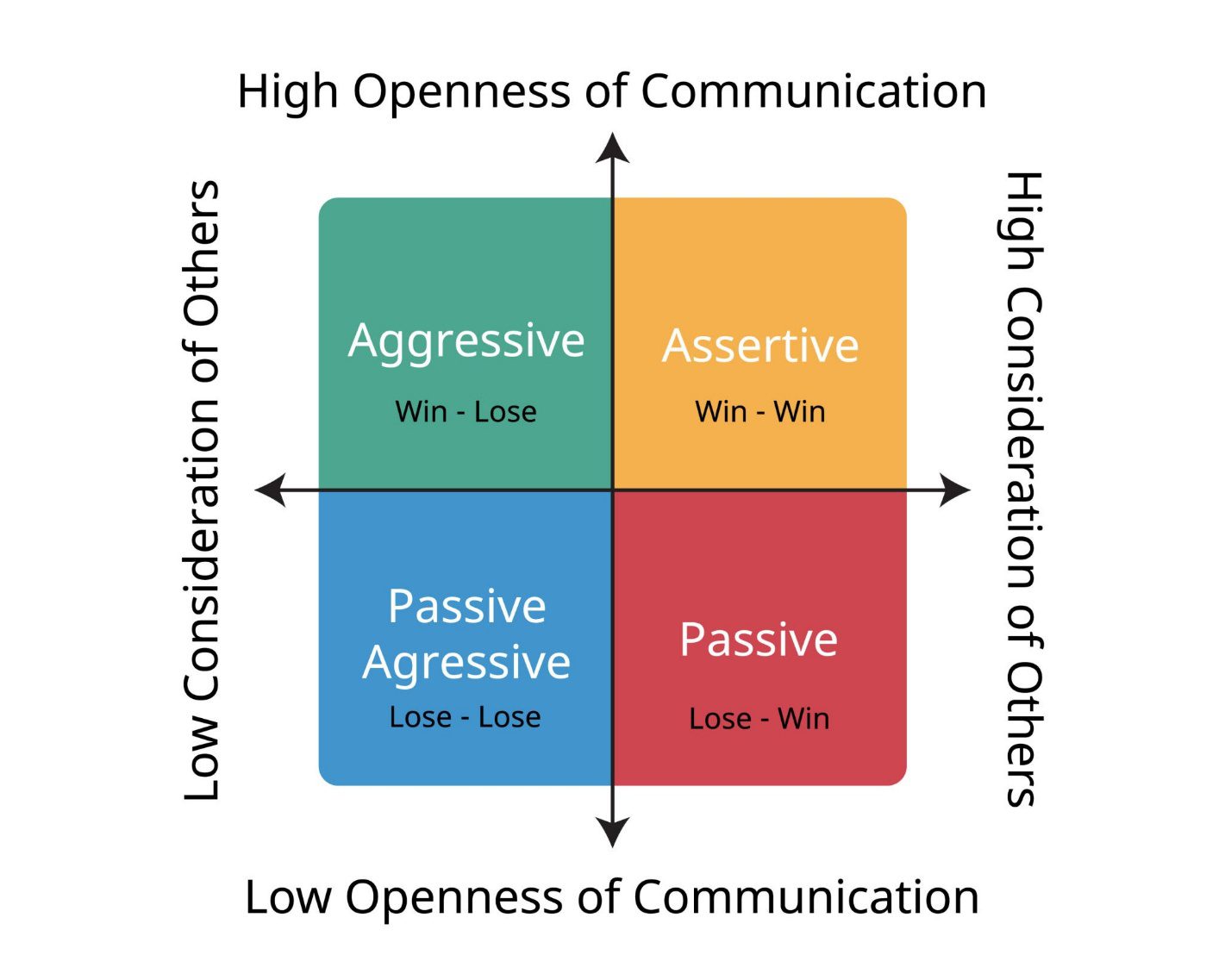
This visualization is a 2×2 matrix that categorizes communication styles into four types: Aggressive, Assertive, Passive-Aggressive, and Passive. These styles are plotted against two axes, representing the degree of openness in communication(Vertical axis: Low to High) and the level of consideration for others (Horizontal axis: Low to High). The matrix illustrates how different combinations of these two factors lead to different outcomes, which directly influence our relationships and self-worth: * Assertive (High Openness, High Consideration): Results in a Win-Winoutcome, reflecting the healthy expression of integrated energy. * Aggressive (High Openness, Low Consideration): Results in a Win-Lose outcome, often stemming from unintegrated anger or power needs (Shadow). * Passive-Aggressive (Low Openness, Low Consideration): Results in a Lose-Lose outcome, typical of suppressed conflict. * Passive (Low Openness, High Consideration): Results in a Lose-Win outcome, often linked to the Inner Critic’s fear of disapproval. * Understanding this matrix helps you choose the Assertive style, which is the productive way to express the reclaimed energy from your Shadow work.
- Example: If you identify a suppressed desire for playfulness or spontaneity (viewed as “unserious”), the behavioral re-entry involves consciously scheduling 15 minutes of non-productive creative time, or accepting an invitation to a light-hearted, unplanned activity.
- Example: If you identify a suppressed desire for genuine emotional intimacy (viewed as “too needy”), the behavioral re-entry involves consciously making one deep, vulnerable statement to a trusted loved one, rather than retreating into emotional distance.
- The Healing Connection: This action validates the Shadow trait’s existence and purpose. This effectively integrates it into the resourceful parts of your personality. The result is increased psychological robustness and authentic self-expression.
Ultimately, successfully integrating a Shadow trait means you gain access to the vital energy that was previously locked away in repression. For instance, reclaiming a disowned desire for attention can transform into authentic self-promotion and confident speaking. This enhances your career success and personal fulfillment. This ability to harness previously feared energy is the mark of genuine self-mastery.
Sustaining Inner Transformation and Healing
Shadow Work isn’t a one-time fix; it is a continuous commitment to inner transformation. The practice strengthens the connection between your conscious mind and your emotional core. This boosts your emotional resilience.
- Journaling: Regularly dedicate time to “Shadow Journaling.” Focus on dream analysis, intense triggers, and recurring judgments you have about others. This provides valuable data for your Shadow Work.
- Mindfulness: Use guided meditations to sit with uncomfortable emotions without acting on them. This creates the necessary space between stimulus and response, a key component of emotional healing.
- Integration and Wholeness: The goal isn’t to eliminate the Shadow, but to make it conscious. When the light of awareness touches the Shadow, the intense, destructive energy neutralizes. This transforms it into functional resources for your whole self.
The Role of Accountability and Community
To avoid the common pitfall of self-deception, establishing external anchors is vital.
- Seeking Feedback: Intentionally seek constructive feedback from trusted friends, partners, or a therapist. They can often spot Shadow projections or cognitive distortions you may overlook. This external accountability prevents stagnation.
- Structured Review: Incorporate a structured review process into your routine. For example, weekly, review your journal entries and apply the CBT method to your social and emotional “errors.” This formalizes your self-improvement efforts.
- Neuroplasticity and Habit: Understand that repeating positive behaviors, such as compassionate self-talk, actually rewires your brain through neuroplasticity. Consistency reinforces the new neural pathways that support integration and self-mastery.
Finally, sustaining this growth requires viewing setbacks not as failures, but as valuable information. When old patterns resurface, treat them as signals that a previously integrated Shadow aspect needs renewed attention or a slightly adjusted approach. This resilient mindset ensures that the ongoing process of healing becomes self-correcting. This continually leads you toward deeper authenticity and psychological freedom.
For more guidance on strengthening your emotional foundation, explore our guide on Identifying and Managing Anxiety and Worry. To review the foundational principles of this approach, see the National Institute of Mental Health
Conclusion: Your Path to Self-Mastery
The journey of Healing, Shadow Work & Inner Transformation is challenging. However, it is the ultimate path to authenticity. By systematically applying CBT-informed tools, you can decode your inner landscape, manage the critic, and integrate the disowned parts of yourself. Every piece of your Shadow you consciously reclaim contributes to a life of greater confidence, peace, and self-mastery.
Ready to transform your inner world? 👉 Explore our CBT resources and downloads👉 Join the BetterMindClub.com for support and guided practice. Here at https://bettermindclub.com/
