
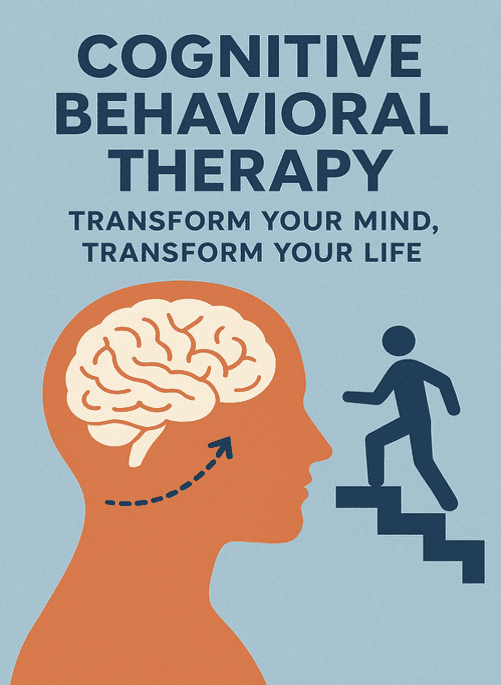
Cognitive Behavioral Therapy (CBT): Transform Your Mind, Transform Your Life
By: Mary Walden for BetterMindClub.com
Introduction: Why CBT Matters for Mental Wellness
At Better Mind Club, we believe mental health is a journey—one that blends science-backed tools with compassionate support. Cognitive Behavioral Therapy (CBT) is one of the most researched and effective methods for creating lasting change in how you think, feel, and act.
This powerful approach teaches you to identify unhelpful thoughts, challenge negative patterns, and replace them with healthier, grounded perspectives. Whether you’re navigating anxiety, chronic stress, low mood, or self-doubt, CBT equips you with practical skills to regain control over your emotional world.
Practical Strategies: Shifting Thoughts and Behaviors
One reason Cognitive Behavioral Therapy (CBT) is so valued is its actionable approach. Instead of dwelling solely on the origins of emotions, CBT emphasizes what you can do right now to shift your thoughts and behaviors. This makes growth accessible—even if you feel overwhelmed—by giving you concrete tools to practice daily.
The Scientific Foundation
Cognitive Behavioral Therapy is firmly grounded in decades of research, demonstrating measurable improvements in:
- Emotional regulation
- Problem-solving abilities
- Long-term resilience
It is widely recommended by leading psychological and medical organizations for anxiety disorders, depression, trauma responses, and stress management.
Community & Compassion: The Better Mind Club Approach
At Better Mind Club, CBT is integrated into a warm, supportive community environment. Here, you don’t just learn concepts—you practice them with guidance, encouragement, and accountability. Our ultimate goal: to help you build a healthier relationship with your thoughts, emotions, and sense of self, one mindful step at a time. By cultivating awareness, self-compassion, and intentional thought patterns, CBT allows you to step out of autopilot and consciously choose thoughts and behaviors aligned with your deepest values.
Cognitive Reframing Examples: Thought Transformation
| Focus Area | Original (Automatic) Thought | CBT Reframed Thought |
| Self-Esteem / Growth | “I’ll never be good enough.” | “I am learning, improving, and capable of growth.” |
| Anxiety / Pressure | “If I make a mistake, people will think I’m incompetent.” | “Everyone makes mistakes. One mistake does not define my ability or worth.” |
| Depression / Motivation | “Nothing I do makes a difference.” | “Small steps count. Even slow progress is still meaningful progress.” |
| Social Anxiety | “People are constantly judging me.” | “Most people are focused on themselves, not evaluating me. I can show up authentically.” |
| Fear of Failure | “If I can’t do it perfectly, I shouldn’t do it at all.” | “Growth comes from trying. I can start imperfectly and learn along the way.” |
| Emotional Overwhelm | “These feelings are too much to handle.” | “My feelings are temporary and manageable. I have coping skills I can use.” |
| Conflict / Relationships | “They’re doing this to hurt me.” | “Their actions may reflect their own stress or perspective. I can respond thoughtfully.” |
Why this works: Cognitive reframing reduces impulsive reactions, self-doubt, and stress while promoting thoughtful problem-solving. Over time, it creates a positive feedback loop: healthier thoughts → confident actions → better outcomes → stronger emotional resilience.
What Is Cognitive Behavioral Therapy (CBT)?
Cognitive Behavioral Therapy (CBT) is an evidence-based approach that explains how thoughts → emotions → behaviors are interconnected. Changing your thinking strategically allows your emotions and actions to follow suit.
Key principles:
- Thoughts are not facts. Automatic thoughts may feel true but often come from fear, habit, or past experiences.
- Mindful awareness slows down these reactions, creating space for objective evaluation.
- Practical techniques like cognitive reframing, thought journaling, and gradual exposure help you take immediate action toward emotional balance.
Example:
- Thought: “I always fail.”
- Reframe: “I’ve succeeded before, and I’m capable of learning through challenges.”
Thoughts vs. Facts: Many “hot thoughts” feel true because of strong emotion, but CBT helps you step back and see them objectively. This creates space for logic, self-compassion, and conscious action.
- Inbound Link: Mental wellness resources
- Outbound Link: Research on CBT effectiveness
How CBT Works at Better Mind Club
| CBT Element | Better Mind Club Approach | Example of Member Practice |
| Identify Negative Thoughts | Journaling + reflection prompts | Logs recurring self-doubt (e.g., “I can’t speak up in meetings”) |
| Challenge Cognitive Distortions | Guided worksheets & group discussion | Examines evidence for/against belief and explores alternatives |
| Build Balanced Thinking | Reframing practices + real-life application | Reframes “I’ll embarrass myself” → “I can contribute meaningfully” |
| Behavioral Experiments | Gradual exposure & skill-building challenges | Practices speaking in small groups before larger meetings |
| Emotional Coping Skills | Breathwork, mindfulness & regulation tools | Uses grounding exercises to reduce pre-meeting anxiety |
Integrated approach: Members combine journaling, reframing, behavioral experiments, and mindfulness to embed CBT skills into daily life, which leads to measurable improvements in confidence and emotional regulation. Moreover, this integration allows individuals to apply what they learn across multiple areas of their lives, from work challenges to personal relationships, thereby reinforcing positive patterns consistently.
The Power of Consistent Practice
Consequently, small daily practices gradually compound, creating lasting behavioral changes and increased resilience. Furthermore, the combination of self-reflection, evidence-based thought adjustment, and real-world application ensures that CBT techniques move beyond theory and become natural, automatic responses. Ultimately, this holistic approach empowers members not only to manage stress more effectively but also to cultivate self-awareness, make intentional choices, and approach challenges with clarity and composure.
Expanded Examples:
- Social Anxiety: Shift “Everyone is judging me” → “Most people are focused on themselves.” Gradual exposure builds self-trust.
- Fear of Public Speaking: “If I speak, I’ll embarrass myself” → “I can speak calmly and clearly.” Repetition reduces anxiety.
- Perfectionism & Work Pressure: “Mistakes mean failure” → “Mistakes are opportunities to learn.” Encourages healthier pacing and balance.
Conditions Supported with CBT at Better Mind Club
CBT supports growth and recovery for:
- Generalized anxiety & social anxiety
- Depression and negative self-talk
- PTSD patterns
- OCD thoughts and compulsive behaviors
- Chronic stress, burnout, and emotional overwhelm
- Outbound Resource: Scientific overview of CBT
Practical CBT Techniques You Can Start Today
- Thought Journaling: Track triggers, automatic thoughts, and resulting emotions.
- Example: “I’ll never do anything right” → evidence review → reframe: “I can learn and improve.”
- Behavioral Activation: Schedule activities aligned with purpose to counter low mood or avoidance.
- Example: 10-minute walk or call a friend boosts engagement and mood.
- Cognitive Restructuring: Compare negative beliefs with objective evidence; reframe constructively.
- Example: “Everyone will judge me” → “I have valuable ideas to share.”
- Mindfulness Integration: Observe thoughts without reacting; create space for intentional responses.
- Example: Notice anxious thought → focus on breathing → attend social event with reduced stress.
Combined Exercise:
- Scenario 1 – Before a Presentation: Journaling → identify fear of judgment → Cognitive Restructuring → reframe to realistic thought → schedule rehearsal → Mindfulness to manage stress → review outcomes and adjust for next practice.
- Scenario 2 – Managing Social Anxiety at a Gathering: Journaling → note automatic thoughts (“They are judging me”) → Cognitive Restructuring → shift to “Most people are focused on themselves” → behavioral experiment → start by engaging in small conversations → Mindfulnessto stay grounded → reflect on experience afterward.
- Scenario 3 – Coping with Work Deadlines: Journaling → capture stress-inducing thoughts (“I’ll never finish this on time”) → Cognitive Restructuring → reframe to “I can prioritize and take it step by step” → break tasks into manageable steps → behavioral activation → track progress → Mindfulness or short grounding exercises → reflect on accomplishments.
- Scenario 4 – Overcoming Negative Self-Talk: Journaling → record self-critical thoughts → Cognitive Restructuring → replace with balanced alternatives → behavioral experiment → intentionally practice a new self-affirming behavior → Mindfulness → review patterns and reinforce positive thoughts.
These combined exercises illustrate how CBT tools can be layered and applied in real-life situations, turning abstract techniques into actionable skills that reduce anxiety, improve confidence, and build emotional resilience. Furthermore, by consistently practicing these layered exercises, individuals begin to internalize the strategies, making them a natural part of their daily responses.
Sustaining Long-Term Change
Over time, this habitual application enhances self-awareness, allowing people to recognize early signs of stress or unhelpful thinking patterns and respond intentionally. As a result, CBT becomes not just a set of techniques, but a framework for proactive emotional management, empowering individuals to navigate challenges with greater clarity, composure, and confidence.
In addition, the skills developed through these combined exercises extend beyond specific situations, enabling individuals to apply them across multiple areas of life—from workplace pressures to personal relationships and unexpected challenges. This generalization reinforces adaptive thinking patterns, strengthens emotional resilience, and fosters a sense of mastery over one’s responses. Ultimately, the integration of CBT into daily routines promotes sustained personal growth, allowing individuals to approach both predictable and unforeseen challenges with confidence, clarity, and intentionality.
Visual CBT Guide: Better Mind Club Step-by-Step
CBT Flowchart:
Trigger → Automatic Thought → Emotion → Behavior → Outcome
↓
Challenge & Reframe
↓
Healthier Outcome
| Step | Example |
| Situation | Received critical feedback |
| Automatic Thought | “I must be failing.” |
| Emotion | Anxiety, self-doubt |
| Challenge | “What is the evidence for/against this?” |
| Reframe | “Feedback helps me grow. This is an opportunity, not a judgment.” |
| Behavior | Ask clarifying questions and adjust plan |
| Outcome | Confidence increases, stress decreases |
Why CBT Creates Lasting Change
From Insight to Skill
CBT focuses on skill-building, strengthening your “emotional regulation muscles.” Repetition rewires neural pathways, making healthier responses automatic. In addition, by practicing these skills across different situations, individuals learn to generalize their new coping strategies, applying them effectively in both familiar and unexpected circumstances. As a result, people gain not only greater emotional stability but also increased confidence in their ability to respond thoughtfully rather than react impulsively. Consequently, this consistent practice fosters long-term resilience, allowing individuals to navigate challenges with greater clarity and intentionality.
Sustaining Your Growth
Beyond immediate improvements, CBT encourages the development of self-sufficiency, enabling individuals to become their own reliable source of support. Moreover, as these skills are reinforced over time, people begin to anticipate potential stressors and apply coping strategies proactively rather than reactively. This forward-thinking approach not only reduces the intensity of emotional responses but also strengthens problem-solving abilities and decision-making in everyday life. Ultimately, the cumulative effect of these practices leads to sustained personal growth, empowering individuals to face challenges with resilience, clarity, and a sense of control over their emotional well-being.
Generalization & Maintenance: Skills developed in one domain (e.g., managing social anxiety) often extend to other areas, such as workplace pressures, interpersonal challenges, or unforeseen life events. Furthermore, this versatility ensures that CBT’s benefits go beyond specific scenarios, supporting broader emotional adaptability and overall mental agility. Additionally, engaging in regular practices—such as journaling, mindfulness, and cognitive restructuring—gradually builds stronger thought habits and diminishes reflexive stress responses. As these routines accumulate, they enhance mental clarity, strengthen resilience, and cultivate lasting emotional balance, empowering individuals to approach challenges with poise and deliberate intention.
Final Thoughts
Cognitive Behavioral Therapy (CBT) with Better Mind Club is more than therapy—it’s a practical life skill toolkit. By identifying unhelpful thoughts and replacing them with constructive alternatives, you gain clarity, confidence, and emotional strength. Guided tools, journaling structures, mindfulness practices, and community support make growth achievable, sustainable, and measurable. With consistent practice, members experience reduced anxiety, improved resilience, and empowered decision-making in both personal and professional life.
Start your CBT Wellness Journey today → Better Mind Club and take the first step toward greater emotional clarity, resilience, and confidence. By exploring our guided exercises, journaling prompts, mindfulness practices, and supportive community, you can begin transforming unhelpful thought patterns into actionable strategies for everyday life. Empower yourself to navigate challenges with intention and cultivate lasting mental well-being—your journey to a healthier, more balanced mindset starts now.
