
Undoing the Inner Critic: Cognitive Distortions Created by Trauma (And How to Heal Them with CBT)
Introduction: The Birth of the Inner Critic
The Inner Critic is not a natural, healthy part of the self; it is a psychological echo of past control, abuse, or systemic invalidation, often a core component of Complex Post-Traumatic Stress Disorder (C-PTSD). When survivors live through years of chronic threat, the mind internalizes the perpetrator’s judgmental, shaming, or critical voice as a survival mechanism. This voice manifests as cognitive distortions—systematic errors in thinking that lead to negative self-perceptions, anxiety, and depression. This guide outlines the 7-phase therapeutic process using Cognitive Behavioral Therapy (CBT) and its advanced tools to dismantle the Inner Critic. For immediate and official resources on trauma recovery, please consult the Substance Abuse and Mental Health Services Administration (SAMHSA) and HHS resources.
Phase 1: Psychoeducation & Neurobiological Understanding
The first step in undoing the Critic is understanding why it exists, shifting the perspective from a moral failing to a biological adaptation.
The Trauma-Brain Connection
Trauma physically alters brain structures related to threat and logic. Specifically, repeated stress can enlarge the Amygdala (the brain’s alarm center) and reduce activity in the Prefrontal Cortex (PFC) (the logical center). This imbalance means the brain is constantly primed for danger, allowing the critical, defensive thoughts to take over easily. You can learn more about the trauma response on our site.
The Role of CBT in Rebalancing
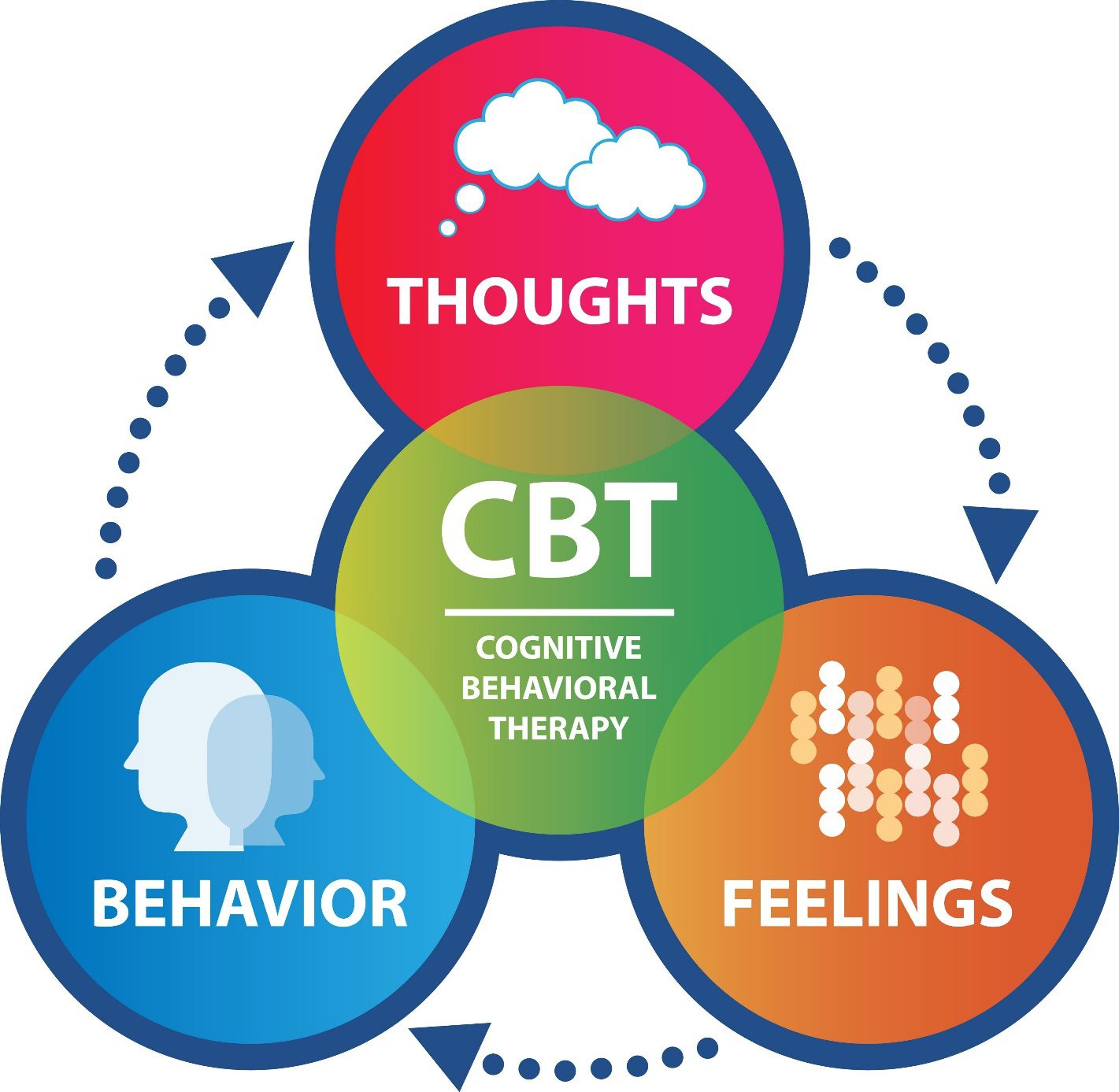
How CBT Intervenes: Cognitive Behavioral Therapy (CBT) works on the principle that your feelings and behaviors are determined by your thoughts. For trauma, CBT techniques gently re-engage the PFC to regulate the Amygdala. By changing the thought patterns (cognitive distortions), we reduce the emotional intensity and restore the brain’s logical control.
Separating Self from Survival Mechanism
Why This Voice Isn’t Yours: The Inner Critic is a defense mechanism, an internalized voice of control—a psychological echo of past harm. Healing involves recognizing this critic as a set of learned, faulty thoughts rather than reflections of your true worth. This differentiation is the foundation of recovery.
Phase 1.5: Applying Neuroplasticity & Habit Stacking
This phase bridges the theoretical understanding of the brain with the practical steps required for neurological change.
Rewiring the Neural Pathways (Neuroplasticity)
Your brain is not a fixed structure; it is capable of radical change—a concept called neuroplasticity. The Inner Critic’s voice is literally a deeply grooved neural pathway, reinforced by years of repetition. Every time you listen and believe the critical thought, you drive that pathway deeper. The ultimate goal of this work is to build a new, stronger pathway: the Wise Adult Pathway.
Neurons that fire together, wire together.
CBT Technique: Habit Stacking for the PFC
You must deliberately replace the old action (believing the critic) with a new action (the CBT reframing). This is called habit stacking. The technique involves pairing the moment you notice the critical thought with an immediate physical action, thereby engaging your Prefrontal Cortex (PFC) control center.
| Cue (Old Pathway) | Routine (New Pathway) | Reward (Neurochemical Change) |
| A critical thought arises. | Take one deep, slow breath while mentally labeling the voice (e.g., “The Judge is talking”). | An immediate, small drop in Amygdala activation, creating a moment of clarity and control. |
| I feel a physical sensation of shame. | Place one hand on your heart and state, “I am having a thought, not a fact.” | A release of oxytocin (the bonding hormone) from self-touch, counteracting the shame-isolation response. |
Phase 2: Identification & Externalization (Naming the Enemy)
Before you can change a thought, you must recognize it. This phase focuses on creating distance from the critical voice.
Creating Psychological Distance
CBT Technique: Externalization & Naming. Give the critical voice a separate, distinct name (e.g., “The Judge” or “The Gremlin”). When a negative thought arises, mentally say, “Oh, there goes The Judge again.” This simple act of naming the voice creates immediate psychological distance, separating you (the listener) from the voice (the speaker).
Understanding the Critic’s Survival Roles
Differentiating the Critic’s Function: Advanced trauma work suggests the Inner Critic often takes three roles, all stemming from survival:
- The Punisher: A direct internalization of the abuser’s voice; it demands compliance and causes shame.
- The Controller: Obsessed with future prevention; it uses “Should Statements” to enforce impossible standards and prevent further injury.
- The Saboteur: Tries to keep you small and isolated, preventing growth that might attract new risk or conflict.
The Power of Neutral Observation
Actionable Step: For the next 24 hours, track every time you notice the Inner Critic speaking. Simply label the thought and its function, but don’t argue—just notice and label it (e.g., “That’s The Controller trying to use a ‘Should Statement'”). Neutral observation is the first step in disempowerment.
Phase 3: Mapping Cognitive & Schema Distortions
This phase involves systematically classifying the Critic’s statements using the CBT framework, introducing the concept of schemas to understand deeper core beliefs.
Categorizing the Errors in Logic
The Top 8 Trauma-Based Distortions: Critic vs. Wise Self: Regular use of these reframes is essential to re-train the PFC.
| # | Distortion | Inner Critic Example | Wise Adult CBT Reframe |
| 1. Black-and-White Thinking | “I messed up that meeting, so I’m an utterly incompetent employee.” | “I am a competent person who had one challenging meeting. A single event cannot define my entire professional identity.” | |
| 2. Overgeneralization | “I got criticized once, so if I speak up again, I’ll be humiliated every time.” | “Past criticism was painful, but this is a new situation. I have evidence of being heard successfully in the past. This is an old fear, not a new fact.” | |
| 3. Emotional Reasoning | “I feel terrified of people, so I must be too weak and fragile to handle the real world.” | “My fear is a powerful feeling (I validate it), but it is based on past trauma, not present danger. I am feeling fragile, but I am strong enough to manage this moment.” | |
| 4. Personalization | “My friend seems distant today. I must have said or done something wrong to push them away.” | “My friend’s mood is about their life, not my behavior. I am not responsible for their emotions, and I have no evidence of causing them harm.” | |
| 5. Catastrophizing | “If I start this new project, I will inevitably fail, lose my money, and ruin my future.” | “The worst-case scenario is unlikely. The most likely scenario is I face challenges, learn from them, and ultimately progress. I can survive setback.” | |
| 6. Should Statements | “I should never need help or take a break; I have to be the strong one.” | “I deserve rest and support. Placing ‘shoulds’ on myself only causes burnout. I can choose to be strong when needed, but also allow myself to be human.” | |
| 7. Mind-Reading | “My boss didn’t look me in the eye. I know he thinks I’m lazy and is planning to fire me.” | “I am making a definitive conclusion based on zero evidence. I cannot know what he is thinking. I will stick to the facts: I completed my work today.” | |
| 8. Discounting the Positive | “Yes, I got a promotion, but anyone could have done it. It was just luck; it doesn’t count as a real achievement.” | “That is the Critic minimizing my effort. I achieved this through hard work and skill. This success is real and counts fully. I will allow myself to celebrate it.” |
Linking Thoughts to Core Beliefs
Introducing Schema Work (Deeper CBT): Cognitive distortions are surface-level errors; Schemas are the deep-seated, painful emotional themes (e.g., Abandonment, Defectiveness, Mistrust) that drive the Critic. Identifying the underlying schema helps target the root belief, not just the thought. Healing requires addressing the belief that the child needed to form to survive the trauma.
Phase 4: Fact-Checking and Schema Reframing (The Core CBT Work)
This is the central process of actively challenging the Critic’s voice using logic and compassion, focused on revising the core belief.
Structured Confrontation
CBT Technique: Journaled Dialogue. This formal method is vital for chronic distortions. Write the Critic’s accusation (the distortion) on one side of a page (e.g., “You are a weak failure.”). On the opposite side, write a compassionate, factual response from your Wise Adult Self (e.g., “I am not a failure; I am a survivor who successfully adapted to an impossible situation, and I am currently handling my responsibilities.”) The written record helps anchor the new, healthy thought.
Defusing the Thought’s Power
The Healing Tool (Cognitive Defusion – ACT): When the Critic is too loud to argue with, challenging it can feel exhausting. Defusion techniques (from Acceptance and Commitment Therapy—a form of CBT) teaches you to see the thought as a thought, not a command. Instead of fighting, try repeating the thought in a silly voice, or adding the phrase: “I am having the thought that I am a failure.” This creates distance without needing to win an argument.
Attacking the Schema
The Healing Tool (Schema Reframing): This process involves targeting the trauma’s core wound. For instance, when a distortion like Overgeneralization is found, reframe the underlying schema. If the schema is Defectiveness, the reframing statement is: “My worth is not defined by external performance; my worth is inherent. I was injured, but I am not broken.”
Phase 5: Somatic & Grounding Integration
Since trauma is stored in the body, healing the Inner Critic requires addressing the physical stress it creates through mindful embodiment.
Anchoring in Present Safety
CBT/Grounding Technique: 5-4-3-2-1 Technique. When the critic’s voice elevates anxiety, use this sensory exercise to immediately anchor yourself in the present moment, where you are safe. This is a direct neurological intervention that interrupts the flashback or catastrophic thinking cycle.
Identifying the Body’s Voice
Somatic Tracking: The critic’s emotional message often arrives as a physical feeling first (e.g., a tight chest, clenching jaw). Pay attention to where the Inner Critic’s stress lands in your body. Acknowledge the physical sensation without judgment. Realize the sensation is the feeling, not the fact, which begins to relax the nervous system’s defense mode.
Phase 6: Cultivating Radical Self-Compassion
This phase focuses on building the antidote to the shame and isolation perpetuated by the Inner Critic.
The Necessity of Kindness
CBT-Rooted Antidote: Self-Compassion Break. The most healing response to the critic is not logic, but kindness. Treat yourself as you would treat a loved one. When the critic attacks, replace judgment with nurturing validation.
Using the Three Components
Healing involves three steps (Mindfulness, Common Humanity, Self-Kindness):
- Mindfulness: Acknowledge: “This is a moment of suffering.”
- Common Humanity: Realize: “All human beings struggle like this.”
- Self-Kindness: State: “May I be kind to myself now.”
Phase 7: Behavioral Reintegration & Wise Self-Assertion
The final phase involves using the newly stabilized mindset to make real-world choices that contradict the Critic’s lies, building a new, authentic narrative and repairing connections.
Establishing Autonomy
Behavioral Tool: Boundary Setting. The Inner Critic often compels people-pleasing (fawning) as a safety measure. Practice setting one small, firm boundary (e.g., saying “No” to a small request, leaving an event early). This directly contradicts the Critic’s core belief that your worth is dependent on pleasing others, asserting your autonomy.
Reclaiming Trust and Connection
Relational Repair: Since the Critic fosters mistrust, practice safe vulnerability with trusted individuals. Share a minor feeling or need. The experience of a non-critical, supportive response is the ultimate behavioral correction to the Critic’s isolationist lies, re-teaching the nervous system that connection is safe.
Living from the Wise Self
Practice: The Wise Adult Voice. The ultimate goal is identity change. Before making any important decision (e.g., a job change, a commitment), ask yourself: “What would the Wise, Compassionate part of me advise right now?” This reinforces the authority of your Wise Adult Self over the fearful, shaming Critic.
Conclusion: Reclaiming Your Inner Narrative
Undoing the Inner Critic is the ultimate act of self-reclamation after prolonged control or harm. By systematically moving through these 7 CBT-based phases, you are not just managing symptoms—you are re-wiring your brain for safety and empowerment. Each challenge weakens the power of the past and reinforces your Wise Adult Self as the true authority over your life.
Ready to go deeper? Start Your Healing Journey with the Better Mind Club.
Frequently Asked Questions (FAQs)
Q: How long does it take to silence the Inner Critic using these techniques?
A: Silencing the Inner Critic is rarely the goal; the goal is to reduce its volume and influence. Because the Critic is a deeply ingrained survival mechanism, this process takes time. You should notice a reduction in the critic’s power (Phase 2 & 4) within a few weeks of consistent practice. Full, sustained change (Phase 7) usually requires months or years of dedicated schema and behavioral work. Be patient and self-compassionate throughout the journey.
Q: Is CBT effective for trauma and C-PTSD, or should I use a different therapy?
A: While traditional CBT focuses heavily on thoughts, trauma-informed CBT (which includes elements like Schema Therapy, Defusion, and Somatic Grounding, as outlined here) is highly effective. For those seeking help or more information on mental health issues, the National Institute of Mental Health (NIMH/NIH) provides resources, and the National Center for PTSD (VA) is a key resource for trauma.
Q: Why do I feel guilt when I challenge the Critic or set boundaries?
A: The guilt is often a signal from The Controller (the Critic’s protective role, Phase 2). You feel guilty because, in your trauma history, compliance and self-blame were necessary to maintain a perceived sense of safety or connection. When you challenge the Critic or set a boundary (Phase 7), you violate that old survival rule, triggering the guilt alarm. The correct response is not to back down, but to apply Self-Compassion (Phase 6) to the guilt, validating the emotion while maintaining the boundary.
Q: Why do I find myself procrastinating on things I genuinely want to do? Is that the Inner Critic too?
A: Yes, absolutely. Procrastination is often a behavioral expression of the Inner Critic’s fear. When you have the underlying schema of Defectiveness or Failure (Phase 3), doing something and potentially failing feels more threatening than not doing it. The Critic (specifically, The Saboteur or The Controller) uses procrastination as a perverse form of protection. If you don’t try, you can’t be judged, criticized, or humiliated. The healing strategy is to apply Fact-Checking (Phase 4) to the task (e.g., “The worst I can do is a mediocre job, and even that is a success because I faced the fear.”) and use Behavioral Reintegration (Phase 7) to start with the smallest possible step. For those needing help finding behavioral health services, please utilize FindSupport.gov.
Q: Are cognitive distortions a sign of weakness?
A: Absolutely not. Cognitive distortions are logical conclusions drawn by a brain operating under prolonged stress and threat. They are systematic errors based on faulty data (the traumatic environment). Recognizing them is a sign of strength and cognitive complexity. They are learned defense mechanisms, not indicators of a character flaw.
